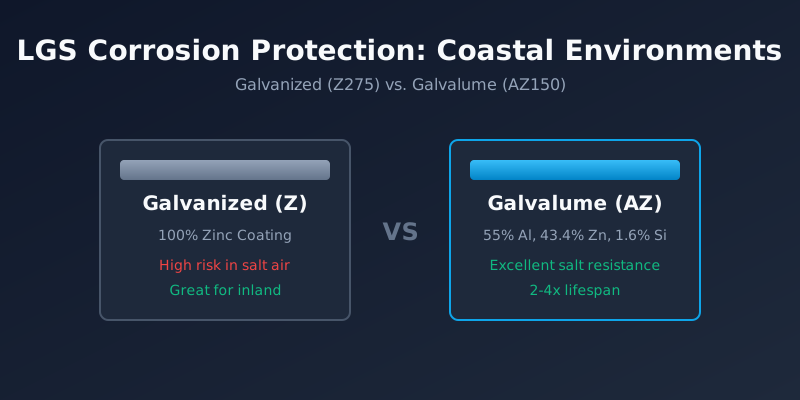
Corrosion Protection in LGS Modular Construction: Galvanized vs. Galvalume for Coastal Projects
An engineering and procurement guide to specifying the correct steel coating for Light Gauge Steel (LGS) modular buildings in coastal environments. Compare Z275 Galvanized vs. AZ150 Galvalume.
When developing Light Gauge Steel (LGS) modular buildings, the structural integrity of the frame is the paramount concern. Unlike traditional timber frames that suffer from rot and termite damage, LGS offers unparalleled dimensional stability and strength. However, steel has its own kryptonite: corrosion.
For procurement teams, developers, and engineers sourcing LGS modular components from overseas, specifying the correct anti-corrosion coating is not a secondary detail—it is the single most important decision determining the Total Cost of Ownership (TCO) and the lifespan of the building. This is especially critical when the final installation site is located in a coastal, high-humidity, or marine environment.
This comprehensive technical guide compares the two dominant anti-corrosion coatings in the LGS industry: Galvanized (Z) and Galvalume (AZ). We will define their chemical mechanisms, establish strict distance-from-coast application boundaries, and provide an actionable procurement checklist to ensure your overseas supplier delivers the specified material.
Scope and limits: This guide is intended for global procurement and engineering teams specifying factory-made LGS or cold-formed steel modular frames for coastal, humid, or marine-adjacent projects. Treat the distance bands below as an RFQ screening rule, not a substitute for local code review, site-specific chloride testing, or a corrosion engineer's project specification.
If you are currently evaluating a structural package for a coastal development, use this guide alongside our LGS technology overview and contact us for a project-specific engineering review.
1. The Chemistry of Corrosion Protection
To make an informed procurement decision, buyers must understand how these coatings protect the underlying high-tensile steel base (typically G550 or S550 grade steel).
Galvanized Steel (The "Z" Designation)
Standard galvanized steel is coated with 100% Zinc. It protects the steel through two primary mechanisms:
- Barrier Protection: The zinc layer blocks moisture and oxygen from reaching the bare steel.
- Galvanic (Sacrificial) Protection: If the coating is scratched or cut, the zinc acts as a sacrificial anode. It corrodes instead of the steel base. As long as zinc remains near the scratch, the steel will not rust.
Common designations include Z275, which means there is a total of 275 grams of zinc per square meter across both sides of the sheet.
Galvalume Steel (The "AZ" Designation)
Galvalume is a patented alloy coating consisting of 55% Aluminum, 43.4% Zinc, and 1.6% Silicon. It combines the best properties of both metals:
- Aluminum: Provides exceptional long-term barrier protection and high-temperature resistance.
- Zinc: Provides the sacrificial protection necessary for cut edges and fastener holes.
- Silicon: Ensures the coating adheres tightly to the steel base during the aggressive roll-forming process.
Common designations include AZ150 (150 grams of aluminum-zinc alloy per square meter). Due to the lower density of aluminum, an AZ150 coating is actually thicker than a Z275 coating.
2. The Coastal Threat: Airborne Chlorides
In mild, inland environments (classified as C1 or C2 under ISO 9223), a standard Z275 galvanized coating can easily last 50 to 100 years without significant degradation. However, coastal environments present a severely aggressive atmospheric condition.
The mechanism of coastal corrosion: Ocean waves crash and release microscopic salt particles (chlorides) into the air. Wind carries these chlorides inland. When chlorides settle on galvanized steel, they react with the zinc coating to form highly soluble zinc chloride. Unlike standard zinc oxide (which forms a protective patina), zinc chloride washes away in the rain or humidity, constantly exposing fresh zinc.
This leads to a rapid depletion of the zinc coating. A Z275 galvanized frame that might last 80 years in an inland desert could fail within 10 to 15 years in a C5-M (Marine) environment.
How Galvalume survives: The aluminum in the AZ coating does not react as aggressively with chlorides. It forms a stable, insoluble aluminum oxide barrier that salt cannot easily penetrate. In extensive salt-spray testing and real-world coastal exposure, Galvalume has demonstrated a lifespan 2 to 4 times longer than standard galvanized steel of equivalent thickness.
3. Structural Comparison Table: Galvanized vs. Galvalume
When preparing an RFQ (Request for Quotation) for an overseas LGS supplier, use the following structural comparison to dictate your specifications.
| Specification Criterion | Z275 Galvanized (100% Zn) | AZ150 Galvalume (55% Al, 43.4% Zn) | Implication for Buyers & Procurement |
|---|---|---|---|
| Primary Protection Mechanism | Heavy Sacrificial (Galvanic) | Strong Barrier + Moderate Sacrificial | AZ is superior for long-term barrier integrity; Z is better if severe scratching occurs. |
| Coastal/Marine Suitability | Poor (Rapid zinc depletion from chlorides) | Excellent (Aluminum resists chloride attack) | Never use standard Z275 within 1km of breaking surf. |
| Inland Lifespan (C2 Environment) | 50 - 100+ Years | 50 - 100+ Years | Both are highly suitable for non-coastal projects. |
| Coastal Lifespan (C4 Environment) | 10 - 20 Years (High risk) | 30 - 50+ Years (Standard) | AZ provides the necessary ROI for coastal developers. |
| Cost Profile (FOB Factory) | Baseline Price | Approx. 5% - 12% Premium over Z275 | The upfront AZ premium is negligible compared to the TCO benefits. |
| Edge Creep Resistance | Excellent (High zinc volume protects edges) | Good (Adequate zinc protects cut edges) | Factory CNC punching must be clean for AZ to perform perfectly. |
| Concrete Contact Compatibility | Good (Tolerates alkaline environments) | Poor (Aluminum reacts badly to wet concrete) | AZ frames must be isolated from direct wet concrete foundations via DPC (Damp Proof Course). |
4. The "Distance-From-Coast" Application Rule
To simplify procurement guidelines, the LGS engineering community relies on the ISO 9223 Corrosivity Classifications to establish "Distance-From-Coast" rules. Procurement teams should map their project site coordinates against these boundaries before specifying the steel coil type.
Zone 1: Severe Marine (0 to 1km from the coast)
- Environment: ISO 9223 Class C5 (Very High Corrosivity)
- Atmosphere: Constant airborne salt spray, high humidity, crashing surf.
- Strict Requirement: AZ150 or AZ200 Galvalume. Furthermore, the steel frame should ideally be situated within a highly sealed, thermally broken building envelope. Standard Z275 Galvanized is explicitly rejected in this zone.
Zone 2: Moderate Coastal (1km to 5km from the coast)
- Environment: ISO 9223 Class C4 (High Corrosivity)
- Atmosphere: Occasional salt smell, coastal fog, moderate chloride deposition.
- Recommendation: AZ150 Galvalume. While heavy galvanized (e.g., Z350 or Z450) could theoretically survive here, it is economically inefficient compared to the standard AZ150 coil. Galvalume remains the dominant and safest specification.
Zone 3: Inland (5km+ from the coast)
- Environment: ISO 9223 Class C2 to C3 (Low to Medium Corrosivity)
- Atmosphere: Normal urban, rural, or arid conditions. Minimal to zero chlorides.
- Recommendation: Z275 Galvanized or AZ150 Galvalume. In these zones, Z275 provides a massive lifespan that easily exceeds the economic life of the building. Buyers can select whichever coil the factory has most readily available at the best price.
5. The Engineering & Procurement Checklist
When sourcing LGS modular components from an offshore manufacturer, you cannot simply trust the marketing brochure. A supplier optimizing for margin may quote an AZ150 specification but sneak a Z275 coil onto the roll-forming machine.
Procurement teams must enforce strict verification protocols. Use this checklist to audit your supplier before the frames are shipped:
- Specify Grade in RFQ: Explicitly write "G550 / AZ150 Galvalume" (or equivalent local standard like S550GD+AZ150) in the original Request for Quotation. Do not accept generic terms like "Anti-Rust Steel" or "High-Tensile Zinc."
- Request the Mill Test Certificate (MTC): Before production begins, demand the MTC for the specific steel coil batch being used for your project. The MTC is a certified document from the raw steel mill (e.g., Baosteel, BlueScope) confirming the tensile strength (e.g., 550 MPa) and the coating mass (e.g., 150g/m² AZ).
- Verify Coil Stamping: Most reputable steel mills ink-stamp the technical specifications directly onto the steel coil. Ask the factory to provide a photograph of the raw coil showing this stamp before it is fed into the CNC machine.
- Check the DPC (Damp Proof Course) Strategy: Because Galvalume (aluminum) reacts negatively to the alkaline moisture in wet concrete, verify that the supplier includes high-quality DPC membranes in the flat-pack kit to isolate the bottom track from the foundation.
- Inspect Fastener Compatibility: Fasteners (screws/bolts) must match the lifespan of the frame. Ensure the supplier is providing Class 3 or Class 4 galvanized or organically coated fasteners that resist corrosion in coastal zones. A 50-year AZ frame will fail if assembled with 5-year zinc-plated indoor screws.
- Review Factory Cutting Processes: The LGS panels should be cut and punched via precision CNC machinery (like FrameCAD or Howick). Avoid suppliers who manually cut panels with angle grinders, as high heat destroys the protective alloy coating at the cut edge.
6. Avoiding the "Cost-Engineering" Trap
A recurring scenario in B2B modular procurement involves "value engineering." A buyer specifies AZ150 Galvalume for a coastal hotel project. A competing supplier offers a quote that is 8% cheaper, claiming their "Heavy Zinc Z275" is "just as good for coastal applications."
This is a false economy. The steel frame typically accounts for only 15% to 20% of the total finished building cost. Saving 8% on the steel frame reduces the total project cost by less than 2%. However, deploying Z275 in a severe marine environment risks catastrophic structural failure within two decades. The remediation cost—stripping exterior cladding to replace rusted structural members—will utterly destroy the project's long-term ROI.
When building near the coast, the coating is the insurance policy for the entire asset. Never compromise on the AZ specification for negligible upfront savings.
7. Next Steps for Procurement Teams
Ensuring the longevity of an imported LGS modular project requires rigorous technical oversight. The decision between Galvanized and Galvalume is just the first step in auditing a supplier's engineering competence.
You must also verify their framing design loads, nesting logistics, and compliance with local seismic and wind codes.
If you are sourcing LGS structures and need to validate a supplier's material specifications, or if you require an engineered, coastal-ready modular solution, contact our engineering support team for a comprehensive technical review and reliable sourcing strategy.
Sources & References
- Cold-Formed Steel Engineers Institute (CFSEI): Technical Note D200-12 on corrosion protection for cold-formed steel framing in coastal areas. CFSEI Technical Note D200-12
- ISO 9223:2012: Corrosion of metals and alloys — corrosivity of atmospheres, the international standard for atmospheric corrosivity classes and chloride deposition context. ISO 9223 Standard
- GalvInfo Center: Technical guidance on 55% aluminum-zinc alloy-coated steel sheet, including Galvalume / AZ coating behavior and composition. GalvInfoNote 1.4
Author

Categories
More Posts
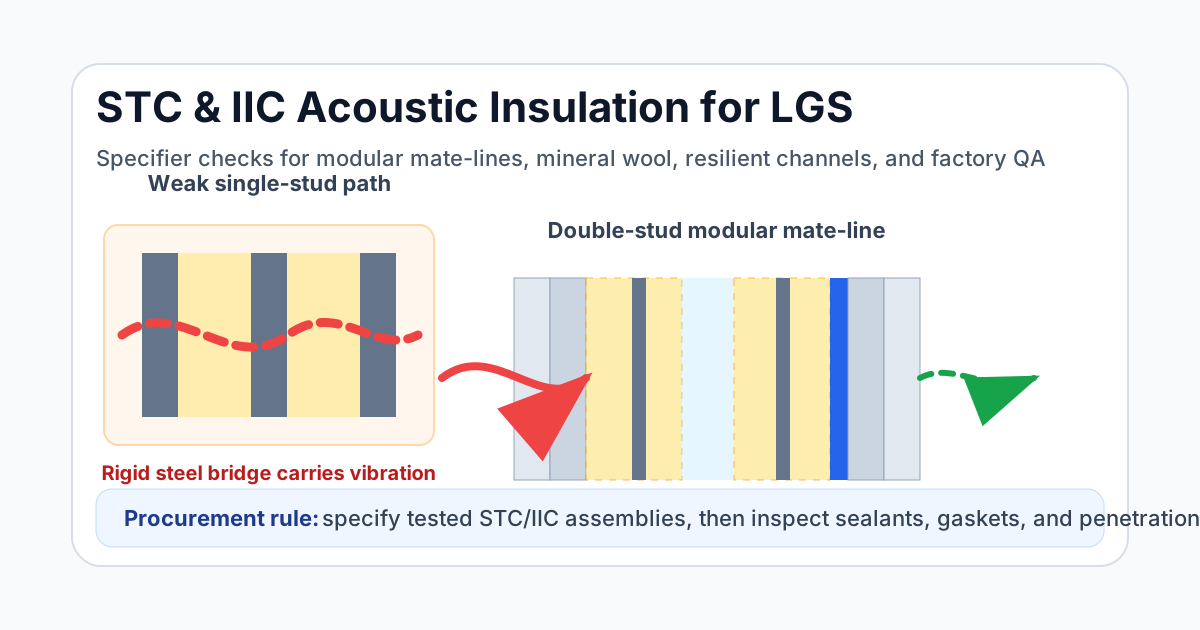
Acoustic Insulation (STC & IIC) in LGS Modular Housing: A 2026 Specifier's Guide
Specify acoustic insulation for LGS modular housing with STC/IIC targets, flanking controls, supplier QA fields, and a technical review CTA from GFK.
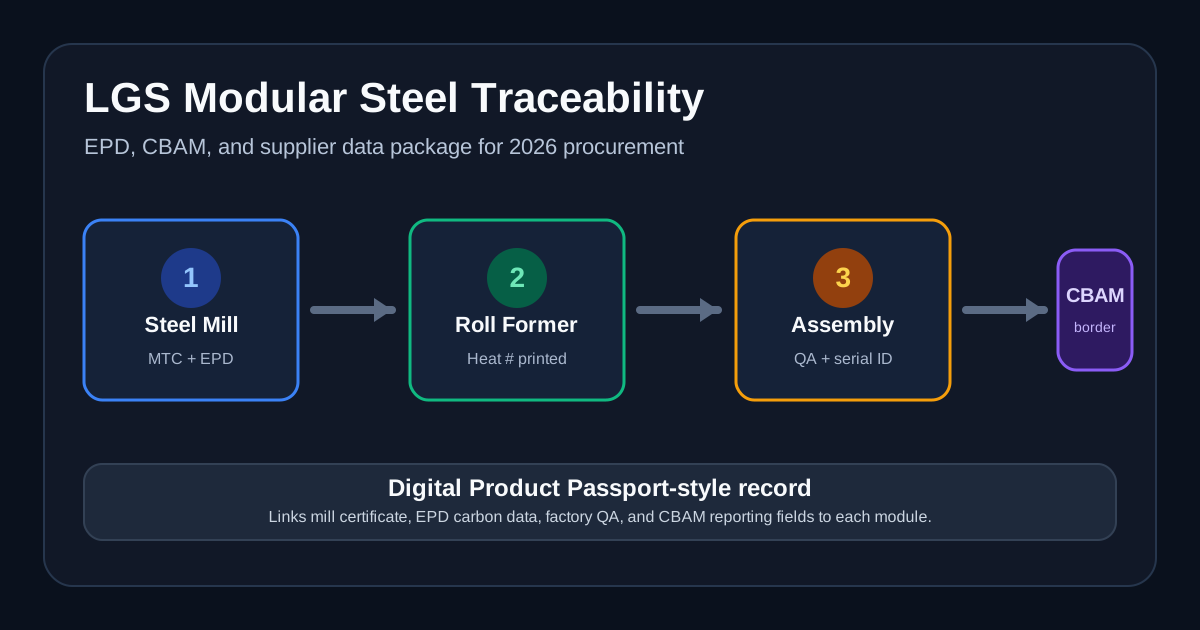
LGS Modular Steel Traceability: Navigating EPDs and CBAM in 2026 Procurement
A 2026 procurement guide to Light Gauge Steel (LGS) modular traceability. Master CBAM compliance, Environmental Product Declarations (EPDs), and supplier verification for cross-border imports.
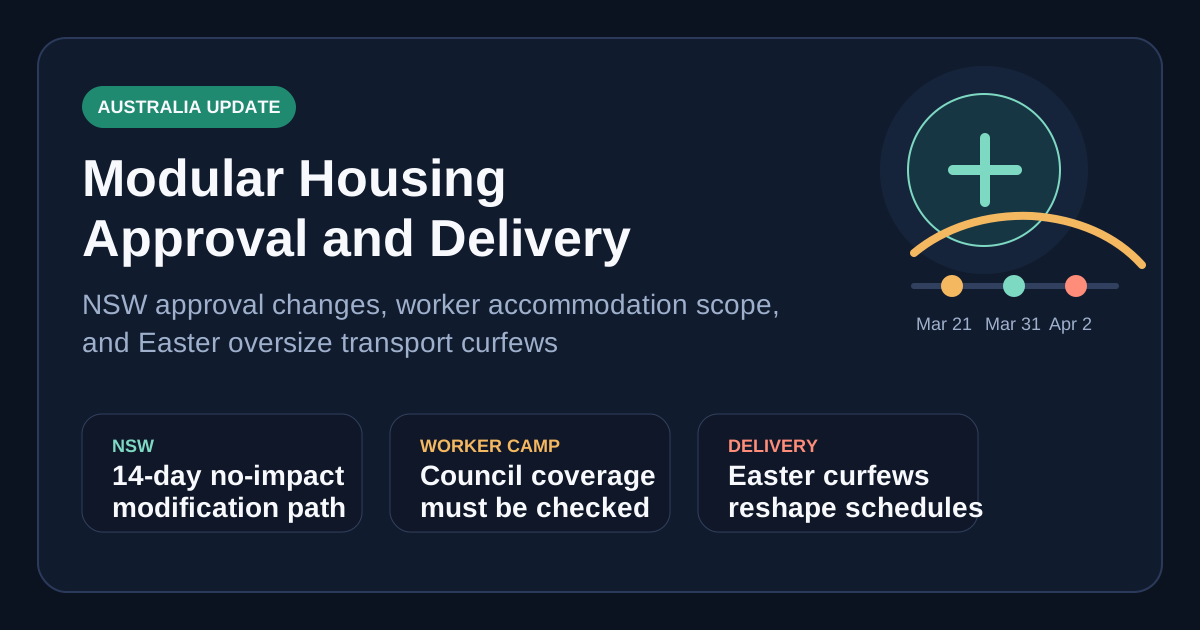
Australia Modular Housing Market Update: NSW Approval Changes and Easter Delivery Curfews
Australia modular housing update for 1 April 2026: NSW 14-day modification rules and NHVR Easter curfews reshape approval and delivery decisions.