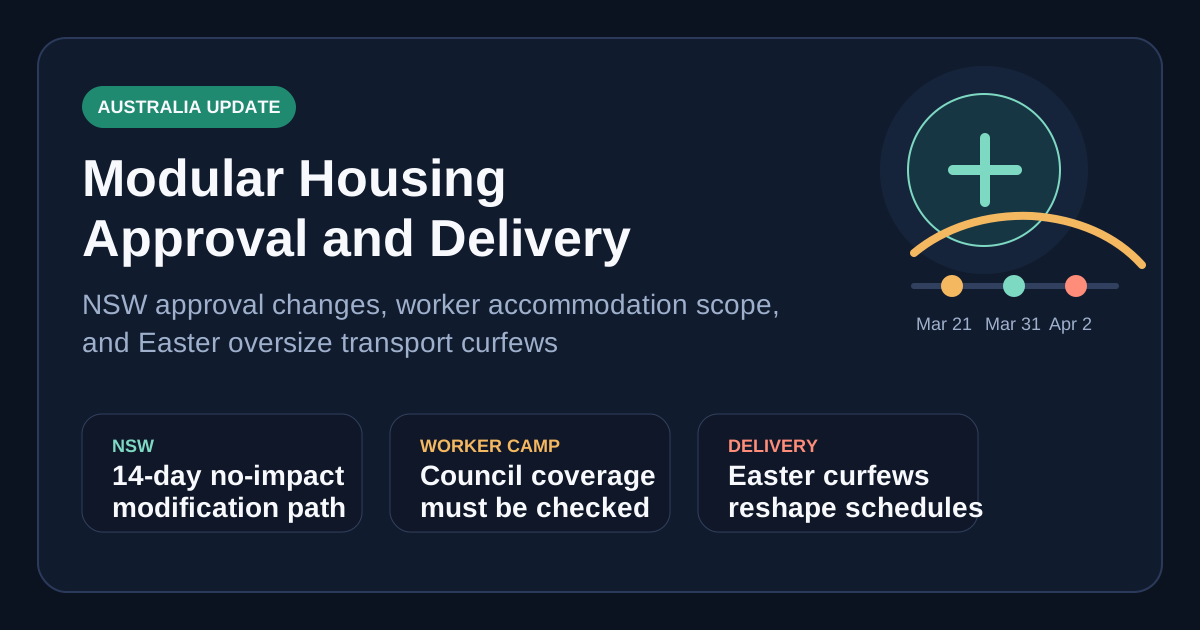
Australia Modular Housing Market Update: NSW Approval Changes and Easter Delivery Curfews
Australia modular housing update for 1 April 2026: NSW 14-day modification rules and NHVR Easter curfews reshape approval and delivery decisions.
This update matters because the live variable in Australia on 1 April 2026 is not a brand-new national granny flat rule. The live variable is a combination of NSW approval handling changes and early-April transport constraints for oversize modular deliveries.
For buyers, builders, modular housing operators, and commercial accommodation teams, the practical message is simple:
- NSW has changed how some already-approved projects can be modified from 21 March 2026.
- NSW has not created an automatic new fast lane for every granny flat or modular home.
- Queensland has not issued a new statewide granny-flat approval reform in the last 30 days.
- NHVR Easter restrictions now affect the delivery window for oversize modular and transportable loads across multiple states.
This page translates official planning and transport language into project decisions. It is not legal advice, and it does not assume that buyer search terms such as "granny flat" always match the approval language used by regulators.
If you need a decision this week:
- New granny flat or secondary dwelling: start with the NSW approval guide or Queensland approval guide.
- Already-approved NSW project with a small change: test whether section 4.55(1) applies before promising a 14-day outcome.
- Oversize April delivery: rebuild the route and holiday-curfew plan before booking cranage, escorts, or site labour.
- Commercial workforce housing enquiry: continue to transportable accommodation or use contact once the project scope is real.
Key conclusions
- NSW's 21 March 2026 reform is most useful for post-approval changes, not for first-time approvals. The March 2026 FAQ says section 4.55(1) now covers modifications with no environmental impact and introduces a 14-calendar-day determination period for that pathway.
- Targeted assessment is real in law but not yet live for a declared modular or granny-flat class. The same NSW FAQ says no development type had been declared eligible for targeted assessment at commencement.
- Construction worker accommodation is the clearest NSW planning lever for moveable dwellings and manufactured homes serving major projects. But buyers now need to verify whether a council was already listed in Housing SEPP Part 13 or opted in before 5 pm on 31 March 2026.
- NHVR's Easter settings now change delivery sequencing. The NHVR's 24 March 2026 notice says Queensland broadly blocks oversize movements from 12:01 am Thursday 2 April 2026 to 11:59 pm Tuesday 7 April 2026, unless an exemption applies.
- Queensland's baseline remains a 2024-position market, not a March 2026 reform market. Queensland's granny-flat and tiny-home pages both still show 30 September 2024 as their last update and continue to require building approval, with local planning approval depending on use and site setup.
- ABCB is a near-term watch item, not this week's approval trigger. On 2 March 2026, ABCB said the NCC 2025 preview was already available and jurisdictions could consider adoption from 1 May 2026.
Scope and method for this brief
- Checked on 1 April 2026: NSW Planning, NHVR, Queensland planning, and ABCB pages listed in the source block below.
- Applies to: expandable homes, transportable accommodation, granny-flat approvals, temporary worker accommodation, and modular deliveries that may move as oversize loads.
- Does not replace: council-specific zoning advice, project-specific legal advice, or route-by-route access checks for Class 1 and oversize movements.
- Why this page exists: to separate buyer search language from the actual approval, project-use, and transport triggers that decide whether a modular project can proceed this week.
Visual 1: What changed, when
Mobile summary
- 2 March 2026: NSW announced planning reforms.
- 21 March 2026: the 14-day no-impact modification pathway started in NSW.
- 24 March 2026: NHVR published Easter travel restrictions that now affect oversize modular deliveries.
- 31 March 2026: the NSW non-listed council opt-in window closed for worker accommodation coverage.
- 1 May 2026: NCC 2025 remains a watch date, not a new live approval rule on 1 April 2026.
What changed, and what did not
| Topic | What changed now | What did not change |
|---|---|---|
| NSW approvals | From 21 March 2026, section 4.55(1) can now cover modifications with no environmental impact, with a 14-day determination period. | NSW did not publish a new statewide rule saying granny flats or modular homes now automatically get a faster first-time approval path. |
| NSW targeted assessment | The legal power now exists to create targeted assessment pathways for certain low-risk development. | NSW's March 2026 FAQ says no development type had been declared eligible at commencement. |
| NSW worker accommodation | NSW broadened the construction worker accommodation settings and invited non-listed councils to opt in by 31 March 2026. | This is not permanent residential housing, and it cannot be casually converted to farm stay, tourist use, or long-term accommodation without a new DA. |
| Queensland granny flats | No new statewide approval reform was found in the last 30 days. | Building approval, plumbing/drainage approval, and local-council checks still matter exactly as before. |
| Delivery | NHVR's 24 March 2026 Easter notice tightens the practical delivery window for oversize movements. | Not every unit is affected. The main impact is on Class 1 / oversize / overmass transport and escorted movements. |
| NCC | ABCB is preparing for NCC 2025 from 1 May 2026. | On 1 April 2026, this is still a preparation and specification issue, not a new live approval rule in most jurisdictions. |
Why it matters now
The market signal in early April is that approval friction and logistics friction have separated.
- If your project is in NSW and already has consent, some low-risk changes may now be easier to process than they were a month ago.
- If your project depends on an oversize road move in the first week of April, your delivery risk is higher, not lower.
- If your business case assumes a broad new granny-flat reform in Queensland, the official record does not support that assumption.
- If you are buying modular or transportable accommodation for a workforce project, NSW's construction worker accommodation pathway is still one of the few official mechanisms that directly speaks to moveable dwellings and manufactured homes, but it is still bounded by eligible project type, council coverage, and temporary-use logic.
Who should care
Granny flat buyers
You should care if you are using search language like "transportable granny flat" or "expandable granny flat" and are about to treat that phrase as an approval category. In both NSW and Queensland, the official planning system still cares more about classification, land use, zoning, and whether the structure is fixed or temporary than about the marketing term on the brochure.
Start with:
- NSW granny flat approval guidance
- Queensland granny flat approval guidance
- National council approval overview
Builders and modular operators
You should care if you already hold an approval and want to change layout, staging, access, or consent wording without creating a new environmental impact. NSW's March 2026 reform may improve your timeline, but only if the change genuinely fits the no environmental impact test.
Commercial accommodation buyers
You should care if you are sourcing moveable dwellings or manufactured-home style units for energy, mining, rail, water, or public-authority projects. NSW's worker-accommodation framework is increasingly important, but it is still a temporary workforce housing pathway, not a backdoor to long-term residential stock.
Approval impact by scenario
| Scenario | Current official reading | Commercial meaning | Recommended next step |
|---|---|---|---|
| New NSW granny flat or secondary dwelling | Existing Housing SEPP rules still govern the basic pathway. Secondary dwellings remain allowed in residential zones and may proceed by DA or complying development depending on the site. | No broad March 2026 shortcut for first-time approvals was found. | Check whether the project is a new application or a post-approval change. Do not sell "21 March reform" as a fresh granny-flat fast track. |
| Approved NSW modular or transportable project needing small changes | Section 4.55(1) now covers modifications with no environmental impact and gives a 14-day determination period after lodgement. | This can reduce idle factory time and avoid rework if the change is truly low risk. | Test the proposed change against the no-environmental-impact threshold before assuming the 14-day pathway applies. |
| NSW construction worker accommodation | Pathway supports temporary housing for workers on eligible large-scale projects, with manufactured homes and moveable dwellings aligned to the relevant regulation. | Stronger planning clarity for worker camps and modular accommodation villages. | Verify the project type, council coverage, minimum scale, and supporting documents before committing to supply. |
| Queensland granny flat or fixed tiny home | No new 30-day reform. Fixed permanent homes can still fall into dwelling house, secondary dwelling, dual occupancy, multiple dwelling, or relocatable home park depending on configuration. | Approval risk remains classification-driven. | Check the planning category first, then building and plumbing approvals, then local overlays. |
| Early-April oversize delivery | Easter curfews now change access conditions in NSW, Queensland, South Australia, and Tasmania. | Site mobilisation and cranage bookings can slip even if factory output is ready. | Rebuild the delivery programme before the truck leaves the yard. |
NSW's March 2026 approval reform: where it helps and where it does not
The key NSW source is not the ministerial media line by itself. The important detail sits in the March 2026 FAQ and the March 2026 practice note:
- section 4.55(1) is no longer limited to clerical corrections and can now cover modifications with no environmental impact
- the determination period is 14 calendar days after lodgement
- the reform applies to modification applications lodged from 21 March 2026, even if the original DA was approved earlier
- if a change introduces any new environmental impact, it cannot use this pathway
- if the application is not determined in time, the consent authority must still determine it and must not refuse it, although it can still impose conditions that do not defeat the purpose of the modification
That matters for modular housing because many real-world changes happen after consent:
- revising siting details after a route survey
- adjusting a condition-only issue
- correcting plan references
- refining a low-risk access or operational detail
It does not automatically solve:
- a new granny flat application
- a new transportable home application
- any change that alters impact distribution, amenity, traffic, biodiversity, heritage, or other environmental factors
- a speculative sales claim that "NSW now fast tracks modular homes"
The March 2026 FAQ is explicit that no development class had yet been declared eligible for the new targeted assessment pathway at commencement. That means you should treat targeted assessment as a future policy tool, not as a current sales promise.
NSW construction worker accommodation: stronger planning language, but still a bounded use
This is one of the most relevant official NSW pathways for transportable and modular accommodation buyers because the planning page and guideline both speak directly to moveable dwellings, manufactured homes, and temporary accommodation for workers on eligible major projects.
Important boundaries from the official NSW material:
- it is for fixed-term temporary housing
- it must support eligible large-scale development or infrastructure projects
- the guideline describes the use as being made up of moveable dwellings, excluding campervans, caravans and tents
- the guideline refers to a minimum of 5 dwellings
- councils may require an accommodation and employment strategy, plan of management, social impact assessment, traffic and transport impact assessment, and decommissioning plan
- the Housing SEPP provisions do not apply when the temporary accommodation is included inside a separate state significant development or state significant infrastructure application
- conversion to farm stay, tourist accommodation, or permanent accommodation needs a new development application
The immediate April 2026 issue is council coverage. NSW says councils not already listed in Part 13 of the Housing SEPP were invited to opt in by 5 pm on 31 March 2026. As checked during this review on 1 April 2026, the NSW Planning page still carries that invitation and we did not locate a post-deadline published expanded council list on official NSW pages. That means buyers should now verify the specific council position rather than assume the broadened pathway applies statewide.
Transport impact: the NHVR Easter window is the real operational change
NHVR's 24 March 2026 Easter notice is immediately relevant because NHVR's OSOM page explicitly lists modular buildings and large prefabricated structures as examples of large indivisible items.
For modular housing delivery teams, this is the section that changes weekly scheduling:
| State | Official Easter position | Practical effect for modular and transportable deliveries |
|---|---|---|
| Queensland | Oversize vehicles must not be driven on any road from 12:01 am Thursday 2 April 2026 to 11:59 pm Tuesday 7 April 2026, unless exempt. | This is the clearest blackout in the sources reviewed. If your unit moves as an oversize load, early-April road delivery should be treated as blocked unless the route and vehicle sit inside an exemption. |
| NSW | Easter restrictions apply for oversize load carrying vehicles during the long weekend, with controls in the NSW operator guide and TfNSW holiday curfews. | Factory-ready does not equal road-ready. Route, zone, holiday-period road list, and dimensions still govern movement. |
| South Australia | No Easter travel for oversize loads that require a police escort. | Escort dependency becomes a hard gating item. |
| Tasmania | No escort service from Friday 3 April 2026 to Tuesday 7 April 2026 inclusive for activities that require escort. | Escorted movements cannot comply and cannot operate unless it is an emergency. |
| Victoria | No specific Easter restrictions were noted, but permit conditions still apply. | Victoria may become the lower-friction side of a cross-border programme, but only if the full route and instrument still work. |
| ACT and NT | No specific Easter restriction was listed. | Low direct impact from the holiday notice, but route-specific permit conditions still matter. |
This is why a good April delivery plan now needs three checks before procurement is locked:
- Is the load actually Class 1 / oversize / overmass?
- Is any leg of the route in Queensland, NSW, South Australia, or Tasmania during the holiday window?
- Does the movement need pilots, escorts, port access, or other exemptions that narrow the workable route even further?
Visual 2: Decision matrix for this week
Mobile summary
- Already approved in NSW with a low-risk change: test the new modification pathway first.
- New NSW granny flat or transportable home: stay on the existing approval pathway and confirm classification.
- NSW workforce accommodation project: verify council coverage, project eligibility, and temporary-use documents.
- Oversize April delivery: re-sequence transport before site mobilisation, cranage, and labour bookings.
Queensland: what the official pages still say
The Queensland sources reviewed for this update do not show a new statewide approval change in the last 30 days.
They still say:
- secondary dwellings can be rented to anyone under the 2022 change, but that does not remove approval requirements
- new secondary dwellings still require building approval
- local councils still need to be checked to determine whether development approval is required before building
- fixed tiny homes can fall into several different planning categories, including dwelling house, secondary dwelling, dual occupancy, multiple dwelling, or relocatable home park
- if a fixed tiny home is compliant and is the only dwelling on the lot or a secondary dwelling, planning approval may not be required, but building and plumbing/drainage approvals may still be required
The important market interpretation is that Queensland remains a classification-first state. If a supplier uses transportable, expandable, granny flat, tiny home, or relocatable language interchangeably, the planning treatment can still diverge materially.
Risks, limits, and common misreads
Risk 1: treating a modification reform like a first-approval reform
The March 2026 NSW change is strongest for approved projects that need small, non-impactful changes. It is not evidence that a fresh modular home or granny-flat application will move through assessment in 14 days.
Risk 2: treating NSW worker accommodation like a general housing shortcut
The official framework is still temporary, project-linked, and document-heavy. It is excellent for the right commercial use case and the wrong tool for long-term residential stock.
Risk 3: booking road delivery off factory completion instead of route conditions
In early April 2026, that is the fastest way to create avoidable slippage. If the move is oversize, the transport instrument now matters more than the production finish date.
Risk 4: mixing buyer vocabulary and planning vocabulary
This is where many avoidable mistakes happen:
- "granny flat" is a demand term
- "secondary dwelling" is a planning term
- "transportable" is a logistics and product term
- "construction worker accommodation" is a specific NSW land-use and project-use term
Those terms overlap in conversation, but they do not always map to the same approval outcome.
Recommended next actions
If you are a granny flat buyer
- Use buyer language to search, but verify the planning category before paying a deposit.
- In NSW, check whether you are dealing with a new approval or only a modification to an existing approval.
- In Queensland, confirm whether the proposal is being treated as a secondary dwelling, dwelling house, or another use class.
If you are a builder or modular supplier
- Separate your sales script into three tracks: new approval, modification, and delivery.
- For NSW modifications, screen every requested change against the no environmental impact threshold before promising timing.
- For Queensland, keep building-approval and local-council steps visible in every quote pack.
If you are a modular housing operator or commercial buyer
- For NSW worker accommodation, confirm project eligibility, council coverage, and temporary-use obligations before procurement lock.
- Prepare the accommodation and employment strategy, traffic/transport material, and decommissioning logic early rather than after site negotiations start.
- Re-sequence oversize delivery windows around the Easter restriction period before committing to April mobilisation dates.
If you need a practical next page
- Read transportable granny flat guidance for buyer-side language and use cases.
- Read transportable accommodation for workforce and project-accommodation framing.
- Use the NSW approval guide and Queensland approval guide when the project is already narrowed to one state.
- Use contact when you need a live project review rather than another generic quote comparison.
FAQ
Did NSW just make granny flats faster to approve?
Not in the simple sense. NSW changed the pathway for some modification applications from 21 March 2026, but the current official materials do not say that all new granny-flat or modular-home applications now get a special fast lane.
Can a transportable modular unit use the new 14-day NSW pathway?
Possibly, but only if the project is already approved and the proposed change has no environmental impact. A fresh approval does not automatically qualify.
What counts as "no environmental impact" in NSW?
The March 2026 practice note says the change must not introduce any new negative environmental impact or increase the severity or distribution of an existing one. If new impacts arise, the application cannot stay in section 4.55(1).
Is targeted assessment already active for modular homes?
No declared modular or granny-flat development class was identified in the March 2026 NSW FAQ. This is a watch list item, not a current buyer promise.
Does NSW's worker-accommodation framework apply everywhere?
No. Listed councils are covered automatically. Other councils were invited to opt in by 31 March 2026. Buyers should now confirm the exact council status instead of assuming statewide availability.
Can NSW construction worker accommodation become tourist or permanent accommodation later?
Not automatically. The official guideline says conversion to other accommodation uses requires a new development application.
Did Queensland change granny-flat approval rules this month?
No official statewide change was found in the last 30 days. The Queensland planning pages reviewed still show 30 September 2024 as their last update.
Are Queensland tiny homes on wheels treated the same as permanent dwellings?
No. Queensland's official page says temporary-use tiny homes on wheels can be treated like caravans, while fixed permanent homes are regulated through the planning and building framework.
Do NHVR Easter restrictions affect every modular delivery?
No. They matter most where the movement is oversize, overmass, or otherwise relies on Class 1 access, notices, escorts, or route-specific conditions.
What is the single biggest mistake buyers can make this week?
Assuming that factory readiness, buyer search intent, and planning classification are the same thing. They are not.
Sources
- Speeding up the planning system to get shovels in the ground sooner. NSW Department of Planning, Housing and Infrastructure. 2 March 2026. Source
- Planning System Reforms (PSR) - Second Proclamation FAQ. NSW Department of Planning, Housing and Infrastructure. March 2026. Source
- Modifications under section 4.55 of the EP&A Act. NSW Department of Planning, Housing and Infrastructure. March 2026. Source
- Planning reforms. NSW Department of Planning, Housing and Infrastructure. Updated 20 March 2026. Source
- Construction workers accommodation. NSW Department of Planning, Housing and Infrastructure. Updated 8 October 2025; page includes 31 March 2026 opt-in deadline. Source
- Guidelines for Construction Workers Accommodation - May 2025. NSW Department of Planning, Housing and Infrastructure. May 2025. Source
- Secondary dwellings. NSW Department of Planning, Housing and Infrastructure. Updated 17 July 2025. Source
- Easter travel restrictions 2026. National Heavy Vehicle Regulator. 24 March 2026. Source
- Oversize Overmass. National Heavy Vehicle Regulator. Current page accessed 1 April 2026. Source
- National notices. National Heavy Vehicle Regulator. Current page accessed 1 April 2026. Source
- New South Wales Class 1 Load Carrying Vehicle Operator's Guide. National Heavy Vehicle Regulator / Transport for NSW support document. PDF accessed 1 April 2026. Source
- Secondary dwellings providing housing solutions. Queensland Department of State Development, Infrastructure and Planning. Last updated 30 September 2024. Source
- Tiny homes. Queensland Department of State Development, Infrastructure and Planning. Last updated 30 September 2024. Source
- February CEO Update - Adrian Piani. Australian Building Codes Board. 2 March 2026. Source
Author

Categories
More Posts
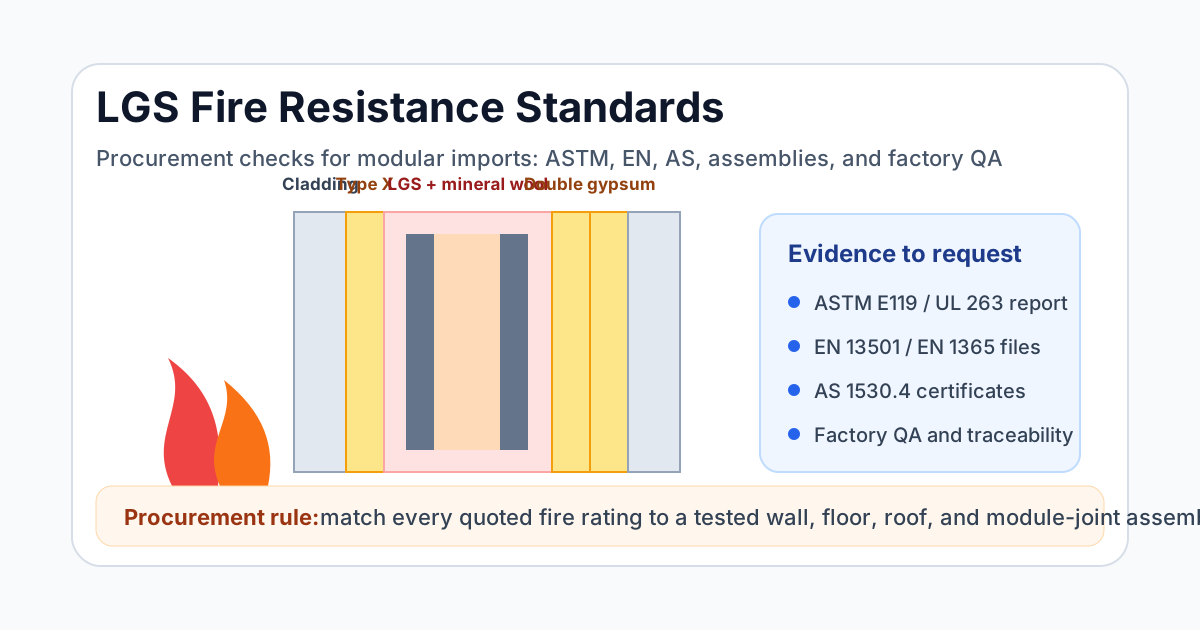
Fire Resistance Standards for Imported LGS Modular Buildings: A 2026 Procurement Guide
Compare LGS fire resistance standards for modular imports, verify supplier test reports, and request GFK engineering review before procurement approval.

How to Evaluate an Overseas LGS Modular Manufacturer: A 2026 Procurement Checklist
A comprehensive guide for developers and procurement teams on auditing Light Gauge Steel (LGS) modular suppliers. Covers ISO standards, CNC automation, steel grades, and QA.
Australia Modular Housing Market Update (Week 17, 2026): NSW Assessment Guidance, NHVR Access Settings, and Buyer Cost Signals
Decision-focused update for 22 April 2026: NSW guidance changes, NHVR notice settings, and cost/dispatch implications for expandable homes and transportable accommodation buyers.