LGS Modular Steel Traceability: Navigating EPDs and CBAM in 2026 Procurement
A 2026 procurement guide to Light Gauge Steel (LGS) modular traceability. Master CBAM compliance, Environmental Product Declarations (EPDs), and supplier verification for cross-border imports.
The global supply chain for Light Gauge Steel (LGS) modular housing has shifted fundamentally in 2026. The defining metric for a viable modular supplier is no longer just the cost per square meter or the speed of factory output; it is data traceability. With the full financial enforcement of the EU’s Carbon Border Adjustment Mechanism (CBAM) and the tightening of environmental reporting across Australia and North America, procurement teams must now treat embedded carbon and steel provenance as critical path requirements.
For buyers, procurement directors, importers, and structural engineers, the practical reality is strict: if a modular supplier cannot prove exactly where their steel comes from, how it was rolled, and what its carbon footprint is, the product carries unacceptable cross-border and compliance risks.
This page outlines the specific procurement boundaries for LGS modular steel traceability, focusing on EPDs (Environmental Product Declarations), CBAM compliance, and the structural verification required to import and deploy modular assets securely.
If you are evaluating a modular project right now:
- Evaluating a new manufacturer: Use the procurement checklist below before requesting a quote.
- Managing cross-border logistics: Review the CBAM boundary definition to determine your carbon tax exposure.
- Seeking immediate supply: Contact GFK Commercial to discuss fully traceable, compliance-ready LGS modular structures.
Key Conclusions
- Mill Certificates are necessary but insufficient. Traditional Mill Test Certificates (MTCs) prove structural yield strength but do not satisfy modern carbon accounting or cross-border emissions taxation requirements.
- CBAM enforces financial penalties for poor data. Importers bringing covered steel-heavy modular goods into regulated zones without primary emissions data can face default values and certificate costs that wipe out the cost arbitrage of offshore manufacturing.
- EPDs are the new baseline for tender pre-qualification. An Environmental Product Declaration is now a standard requirement for supplying modular units to government, healthcare, and Tier-1 commercial developers.
- Traceability is a structural engineering requirement. Unbroken traceability from the coil to the assembled wall panel is the only way a certifying engineer can sign off on local structural codes without demanding destructive testing.
- Digital Product Passports (DPP) are bridging the gap. Progressive manufacturers are replacing paper trails with digital twins that attach chemical, structural, and environmental data directly to the physical module.
1. The End of Mill Certificates as the Sole Standard
Historically, procuring LGS modular housing relied on a simple documentation chain: the supplier provided a Mill Test Certificate (usually EN 10204 Type 3.1) proving that the galvanized or galvalume steel coils met the required grade (e.g., G550 or S350GD). If the steel met the yield strength, the procurement checklist was satisfied.
In 2026, this approach is dangerously incomplete. A standard MTC confirms the chemical composition and mechanical properties, but it provides zero visibility into the environmental cost of that steel. It does not state whether the steel was produced in an Electric Arc Furnace (EAF) using renewable energy or a traditional Basic Oxygen Furnace (BOF) powered by coal.
For engineers, the MTC is still the holy grail of structural safety. For procurement teams and corporate compliance officers, it is only step one. The new paradigm requires a triad of data:
- Mechanical Data: Yield strength, tensile strength, elongation (via MTC).
- Coating Data: Zinc or Aluminium-Zinc mass (e.g., AZ150, Z275) to prove design life and corrosion resistance.
- Environmental Data: Global Warming Potential (GWP) measured in kg CO2-eq per kg of steel.
Suppliers who cannot map their MTCs directly to their environmental data are functionally operating blind, passing the compliance risk directly to the importer.
2. Understanding CBAM Boundaries in Modular Imports
The Carbon Border Adjustment Mechanism (CBAM) is the European Union’s tool to put a fair price on the carbon emitted during the production of carbon-intensive goods entering the EU. While initially focused on raw commodities like cement, iron, and steel, its practical enforcement boundary heavily impacts prefabricated construction.
The Classification Risk
When you import an LGS modular building, customs authorities classify the import using Combined Nomenclature (CN) codes. Raw steel structures often fall under chapter 73, which is strictly monitored under CBAM. Fully prefabricated buildings generally fall under CN code 9406.
However, if a modular unit is shipped as "flat-pack" steel frames, structural cassettes, or discrete steel assemblies, the declared CN code may fall under covered iron and steel categories rather than a complete prefabricated-building category. If the goods are classified under covered steel codes, the importer must report embedded emissions and, under the definitive CBAM regime, surrender CBAM certificates for the covered goods. Treat classification as a broker/customs decision, not a supplier marketing claim.
Default Values vs. Actual Data
If your offshore manufacturer cannot provide verified primary emissions data for the steel they use, the importing authority may require default values instead of supplier-specific data. These defaults can be financially unfavorable compared with verified actual emissions, which means importing a modular steel package without traceability can erase the unit's initial cost advantage.
Procurement teams must demand that manufacturers use steel from mills that track Scope 1 and Scope 2 emissions accurately, allowing the importer to declare actual (and usually much lower) emissions data rather than paying the default penalty.
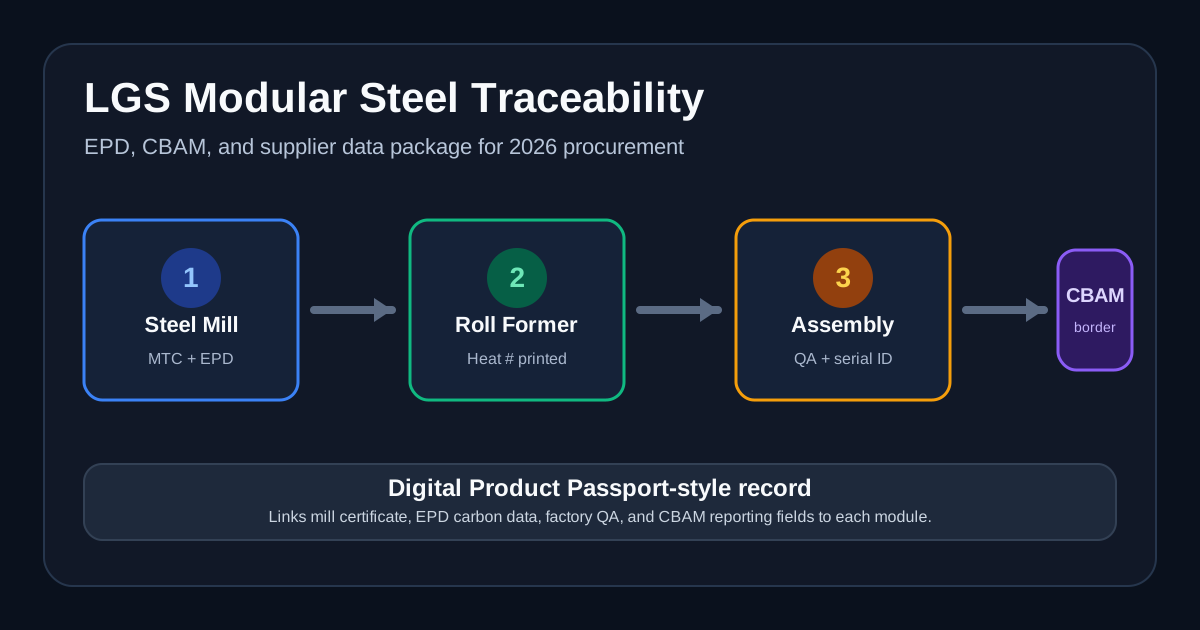
Visual 1: The LGS Steel Traceability Chain
3. The Role of EPDs (Environmental Product Declarations) in LGS
An EPD is a verified and registered document that communicates transparent and comparable information about the life-cycle environmental impact of products. For Light Gauge Steel, the EPD quantifies the Global Warming Potential (GWP) of the steel per kilogram.
Why does this matter for procurement?
When a Tier-1 developer or a government agency specifies a new accommodation village or a multi-story modular project, they are increasingly bound by strict ESG (Environmental, Social, and Governance) targets. They must report the embodied carbon of the building. Because LGS forms the entire structural skeleton of these modules, the steel accounts for the vast majority of the unit's upfront embodied carbon (Stage A1-A3 emissions).
If you purchase modules from a supplier using undocumented steel, you cannot provide accurate embodied carbon data to your client. You will be forced to use generic industry averages, which are heavily penalized in green building rating systems (like LEED, BREEAM, or Green Star). Conversely, a supplier who sources from mills with highly efficient EAF production and provides verified EPDs allows the project to claim significant carbon savings, directly increasing the commercial value of the modular asset.
4. Traditional FAT vs. Modern Traceability
The gap between old-school quality control and modern procurement compliance is stark. A standard Factory Acceptance Test (FAT) verifies that the walls are straight; modern traceability verifies that the supply chain is legal.
| Assessment Area | Traditional Procurement (Pre-2024) | Modern Traceability (2026 Standard) | Commercial Impact of Failure |
|---|---|---|---|
| Material Proof | Supplier emails a generic Mill Test Certificate (MTC). | MTC is electronically linked to heat numbers stamped directly on the cold-formed steel studs. | Engineers reject the structure, demanding destructive core testing on site. |
| Carbon Accounting | Not requested; assumed to be a factory problem. | Supplier provides a verified EPD/LCA record plus CBAM direct and indirect emissions data for covered steel inputs. | Disqualification from government tenders and green-star rated projects. |
| Customs & Import | Modules cleared strictly on Harmonized System (HS) codes. | Importer must submit verified embedded emissions data via CBAM portals. | Less favorable default values and certificate costs can destroy project margins. |
| Design Life Verification | Supplier promises "Z275" galvanization. | Coating mass is verified via third-party SGS/TUV testing tied to the coil batch number. | Premature corrosion, warranty failure, and uninsurable assets. |
| Data Handoff | A PDF dossier provided via email upon shipment. | A Digital Product Passport (DPP) or secure portal hosting live QA and compliance data. | Thousands of dollars lost in manual document reconciliation and compliance audits. |
5. Procurement Checklist: Evaluating Traceability Capability
Do not issue a Purchase Order for LGS modular structures until the manufacturer can successfully pass this six-point traceability check.
- 1. Coil Provenance: Can the manufacturer identify the exact steel mill that produced the parent coil for your project?
- 2. Heat Number Stamping: Does the manufacturer’s roll-forming machine (e.g., FRAMECAD, Howick) automatically inkjet-print the steel heat number and part code onto every single steel stud?
- 3. EPD Availability: Can the manufacturer provide a valid, third-party verified Environmental Product Declaration for the specific grade and coating of steel being used?
- 4. MTC to Invoice Linkage: Can the supplier trace a specific wall panel on your packing list back to the specific MTC of the coil used to form it?
- 5. Fastener Traceability: Traceability is not just for steel studs. Can the supplier provide technical data sheets and corrosion-resistance guarantees for the structural screws/rivets used in assembly?
- 6. CBAM Readiness: If importing to the EU, does the manufacturer have the data infrastructure to provide the required direct and indirect emissions reporting to support your CBAM declarations?
If a supplier answers "no" to any of these questions, they are treating modular housing as a simple commodity rather than a highly regulated engineered asset.
6. Procurement & Engineering Decision Matrix
To operationalize traceability, buyers and engineers must align on specific decision points. The following matrix outlines the specification dimensions, failure risks, buyer decision points, and essential supplier communication fields across different project scopes.
| Project Scope / Boundary | Specification Dimension | Buyer Decision Point | Supplier Communication Field | Failure Risk (If Traceability is Missing) | Engineering & Compliance Action |
|---|---|---|---|---|---|
| EU / CBAM Regulated Imports | Embedded Carbon (Scope 1-3) & Primary Data | Is the supplier's EPD third-party verified and product-specific? | "Please provide the EPD and CBAM direct/indirect emissions report for your G550/S350GD steel." | Default values and certificate costs applied at the border; project ROI destroyed. | Mandate DPP or linked EPDs before issuing the PO. |
| Multi-Story / High-Load Modules | Yield Strength (e.g., 550 MPa) & MTC verification | Can we link the physical wall panel to the exact MTC? | "Provide the QA log showing coil heat numbers matched to roll-formed part codes." | Structural failure under load; structural engineer refuses to sign off. | Require mandatory inkjet printing of heat numbers on all studs. |
| Coastal / Cyclonic Regions | Coating Mass (e.g., AZ150, Z275) | Does the MTC confirm the coating thickness matches the environmental corrosivity category? | "Confirm AZ150 coating via SGS/TUV testing on the parent coil." | Premature corrosion, compromised structural integrity, uninsurable assets. | Independent third-party testing of coating thickness prior to assembly. |
| Government / ESG-Mandated Tenders | GWP (Global Warming Potential) per kg of steel | Does this steel allow us to hit our embodied carbon targets for the tender? | "What is the kg CO2-eq per kg of your steel? Is it EAF or BOF produced?" | Disqualification from the tender or loss of green building certification. | Integrate GWP limits directly into the supplier contract and SLA. |
| Temporary / Non-Habitable Sheds | Basic Material Provenance | Is the cost savings worth the unknown origin? | "Supply basic MTC showing chemical composition and yield." | Minimal compliance risk, but still exposed to basic material failure. | Accept lighter traceability, but maintain visual FAT and random sampling. |
| Domestic / Low-Risk Residential | Standard Local Code Compliance | Will the local building authority accept generic certification? | "Provide a generic structural certificate covering the design." | Potential delays in local council approval if the generic certificate is challenged. | Use local certifying engineers who accept the supplier's standard documentation. |
7. Limitations and Boundaries: When Full Traceability is Overkill
It is important to define the application boundaries of these requirements. Not every structure requires a forensic level of carbon accounting.
Where strict traceability (EPDs, CBAM) is non-negotiable:
- Imports into the European Union or jurisdictions with active carbon border pricing.
- Projects funded by government bodies, Tier-1 developers, or institutional investors with hard ESG mandates.
- Multi-story modular construction where structural loads are critical and engineering sign-off requires absolute proof of yield strength.
- Coastal or cyclonic regions where the zinc/aluminium coating mass determines the survival of the building.
Where lighter traceability is acceptable:
- Small, single-story agricultural outbuildings.
- Temporary, non-habitable site sheds in unregulated zones.
- Domestic projects in jurisdictions where the local authority accepts generic engineer certification without demanding primary batch data.
However, even in low-risk scenarios, relying on a supplier who lacks basic MTC traceability exposes the buyer to severe quality risks, including using under-strength or under-coated steel.
8. FAQ
Does CBAM apply to fully assembled LGS modular homes or just raw steel?
It depends on the customs classification (CN code) declared for the imported goods. Steel coils, profiles, frames, and structures under covered iron and steel CN codes are in scope. A complete prefabricated building declared under CN 9406 is not automatically treated the same as raw steel, so importers should confirm the classification with a broker or customs authority before relying on a CBAM exclusion.
Can a mill certificate replace an EPD?
No. A mill test certificate (MTC) verifies the chemical composition, tensile strength, and yield strength of the steel batch. An Environmental Product Declaration (EPD) quantifies the lifecycle environmental impact, including greenhouse gas emissions, required for modern carbon accounting.
What is the difference between Scope 1, 2, and 3 emissions in modular manufacturing?
Scope 1 covers direct emissions from the manufacturer (e.g., fuel used in the factory). Scope 2 covers indirect emissions from purchased electricity. Scope 3 covers all other indirect emissions in the value chain, primarily the embodied carbon in the raw steel sourced from the mill and the logistics to transport it.
Do I need a Digital Product Passport (DPP) for modular imports today?
Not as a single universal requirement for every modular import today. EU digital product passport obligations are being phased in through product-specific rules, but leading procurement teams are already enforcing DPP-like traceability requirements in 2026 to de-risk future compliance and streamline ESG reporting.
How does traceability affect structural engineering sign-offs?
Traceability links the physical steel profile installed in the module back to the specific MTC and structural test data. Without unbroken traceability, engineers cannot definitively prove the installed cold-formed steel meets the required AS/NZS 4600 or Eurocode 3 standards, often leading to costly destructive testing on site.
What exact information should I ask my supplier to provide during the initial inquiry?
You must explicitly request their 'Steel Traceability and Carbon Data Package'. This should include an example MTC, their EPD for the specific coil grade, and a demonstration of how they link heat numbers from the coil to the roll-formed profiles. If they cannot provide these three elements, they cannot support a compliant procurement process.
9. Working with GFK Commercial
Procuring offshore LGS modular housing without guaranteed traceability is no longer a viable commercial strategy. The compliance burden has shifted to the importer, and the financial penalties for poor data are severe.
At GFK Commercial, our modular supply chains are built on data integrity. We ensure that every structural LGS component is fully traceable, backed by legitimate Mill Test Certificates, and supported by the environmental data necessary to navigate modern procurement standards. We bridge the gap between cost-effective offshore manufacturing and the rigid compliance demands of global building codes and carbon accounting.
Ready to de-risk your modular supply chain? Contact the GFK Commercial procurement team today to discuss how our transparent manufacturing processes can support your next major project.
10. Sources & References
- Carbon Border Adjustment Mechanism (CBAM) Guidelines - European Commission official taxation and customs union documentation.
- ResponsibleSteel Certification Standards - Global multi-stakeholder standard and certification initiative for the steel industry.
- Life Cycle Thinking and EPDs for Steel - World Steel Association data on greenhouse gas accounting and environmental product declarations.
- EU product labelling rules and sustainable products - European Commission context for product-specific digital product passport rollout.
Author

Categories
More Posts
Australia Modular Housing Market Update (Week 17, 2026): NSW Assessment Guidance, NHVR Access Settings, and Buyer Cost Signals
Decision-focused update for 22 April 2026: NSW guidance changes, NHVR notice settings, and cost/dispatch implications for expandable homes and transportable accommodation buyers.
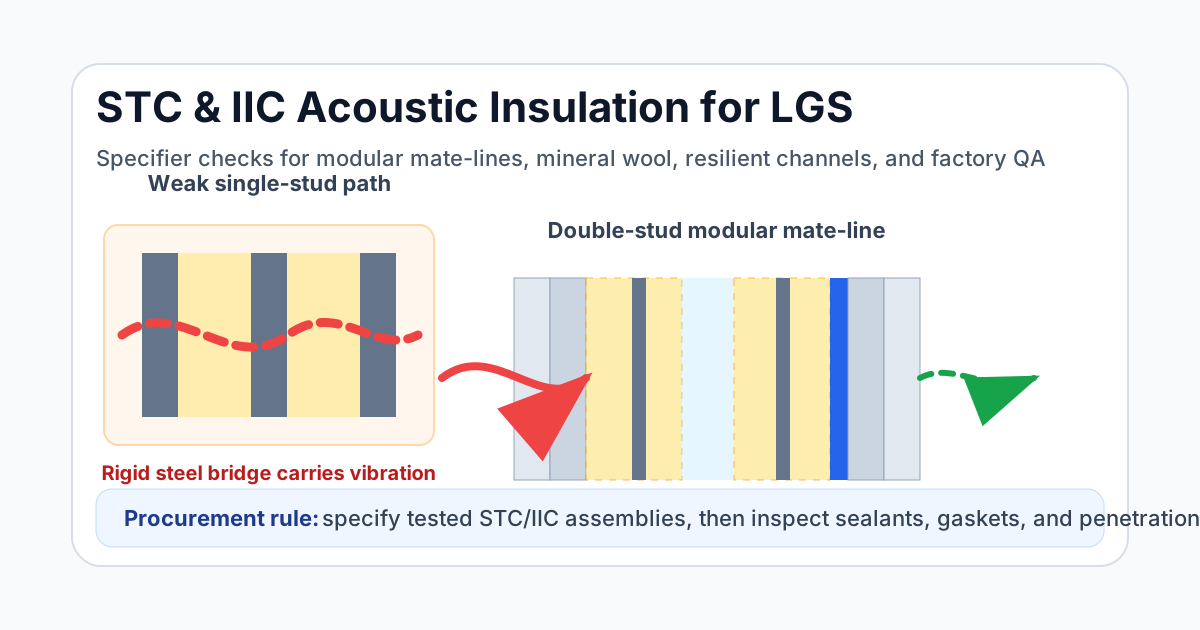
Acoustic Insulation (STC & IIC) in LGS Modular Housing: A 2026 Specifier's Guide
Specify acoustic insulation for LGS modular housing with STC/IIC targets, flanking controls, supplier QA fields, and a technical review CTA from GFK.
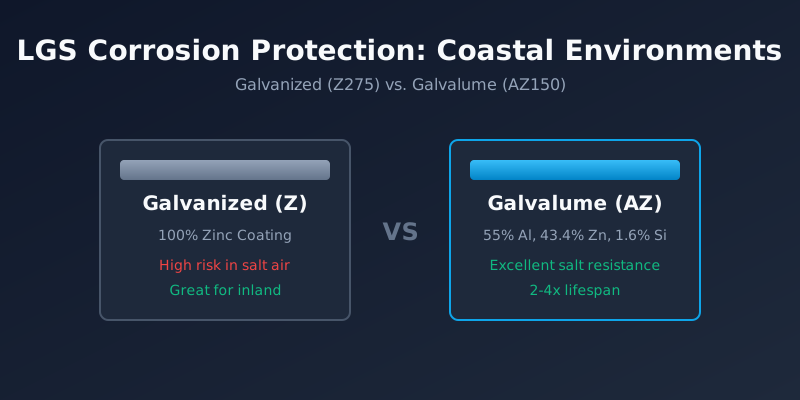
Corrosion Protection in LGS Modular Construction: Galvanized vs. Galvalume for Coastal Projects
An engineering and procurement guide to specifying the correct steel coating for Light Gauge Steel (LGS) modular buildings in coastal environments. Compare Z275 Galvanized vs. AZ150 Galvalume.