Acoustic Insulation (STC & IIC) in LGS Modular Housing: A 2026 Specifier's Guide
Specify acoustic insulation for LGS modular housing with STC/IIC targets, flanking controls, supplier QA fields, and a technical review CTA from GFK.
When commercial developers and procurement teams evaluate Light Gauge Steel (LGS) modular construction for multi-family, hotel, or student accommodation projects, one objection consistently surfaces: "Is steel framing noisy?"
In the early days of lightweight steel construction, inadequate acoustic detailing led to a reputation for poor sound isolation. However, in 2026, the engineering behind LGS modular housing has evolved dramatically. Today, precision-manufactured LGS assemblies not only meet but frequently exceed the strictest international acoustic building codes.
For procurement managers, architects, and structural specifiers, understanding how to request, evaluate, and verify acoustic performance from an overseas OEM manufacturer is critical. Failing to specify the correct acoustic assemblies before production begins can lead to catastrophic code failures on site—issues that are prohibitively expensive to retrofit.
This comprehensive guide breaks down the engineering principles of sound transmission in cold-formed steel, details the exact material assemblies required to achieve high ratings, establishes clear buyer decision points, and provides a rigorous procurement checklist to ensure your imported modular units deliver a premium, whisper-quiet living environment.
1. Demystifying Acoustic Metrics: STC, IIC, and NRC
Before specifying materials to a modular factory, it is essential to establish a baseline understanding of the global acoustic metrics governing building compliance. In commercial and high-density residential development, three metrics dictate the specification parameters:
Sound Transmission Class (STC)
STC measures a structure's ability to resist airborne sound transfer. This includes voices, television noise, music, and traffic. The higher the STC rating, the less sound transmits through the wall or floor assembly.
- STC 30-35: Normal speech can be heard clearly and understood. (Typical of uninsulated interior stud walls).
- STC 40-45: Loud speech can be heard but is generally unintelligible.
- STC 50: Loud speech is faintly heard. (The minimum building code standard for multi-family demising walls in the US under IBC Section 1206).
- STC 60+: Excellent soundproofing; loud sounds are barely audible. (The luxury hotel and premium apartment standard).
Specification Dimension & Applicability Boundary: STC primarily targets mid-to-high frequency noises (125 Hz to 4000 Hz). It is important to note that STC is notoriously poor at reflecting low-frequency noise isolation, such as heavy bass from home theater subwoofers or mechanical rumble. If your project is near an airport or an industrial zone, you must look beyond STC and specify Outdoor-Indoor Transmission Class (OITC), which places more emphasis on lower frequencies.
Impact Insulation Class (IIC)
IIC evaluates a floor/ceiling assembly's resistance to structure-borne impact noise, such as footsteps, dropped objects, or sliding furniture. Like STC, the International Building Code (IBC) requires a minimum IIC of 50 for floor assemblies separating dwelling units. Achieving high IIC in LGS modular often requires specialized underlayments, acoustic mats, and resilient ceiling isolation below the steel joists.
Noise Reduction Coefficient (NRC)
NRC measures how much sound a material absorbs rather than reflects. While STC deals with sound passing through a wall, NRC deals with sound echoing within a room. NRC is a scalar value from 0.0 (perfectly reflective) to 1.0 (perfectly absorptive). In LGS modular, NRC is heavily influenced by the cavity insulation (e.g., mineral wool) used within the steel frame.
Specifier's Boundary: Never accept a manufacturer's claim of "good soundproofing." Acoustic performance is highly regulated and quantitative. Always mandate exact STC and IIC targets in your procurement documentation, referencing specific testing standards such as ASTM E90 (for STC) and ASTM E492 (for IIC).
2. The Physics of Sound in LGS and the Flanking Noise Challenge
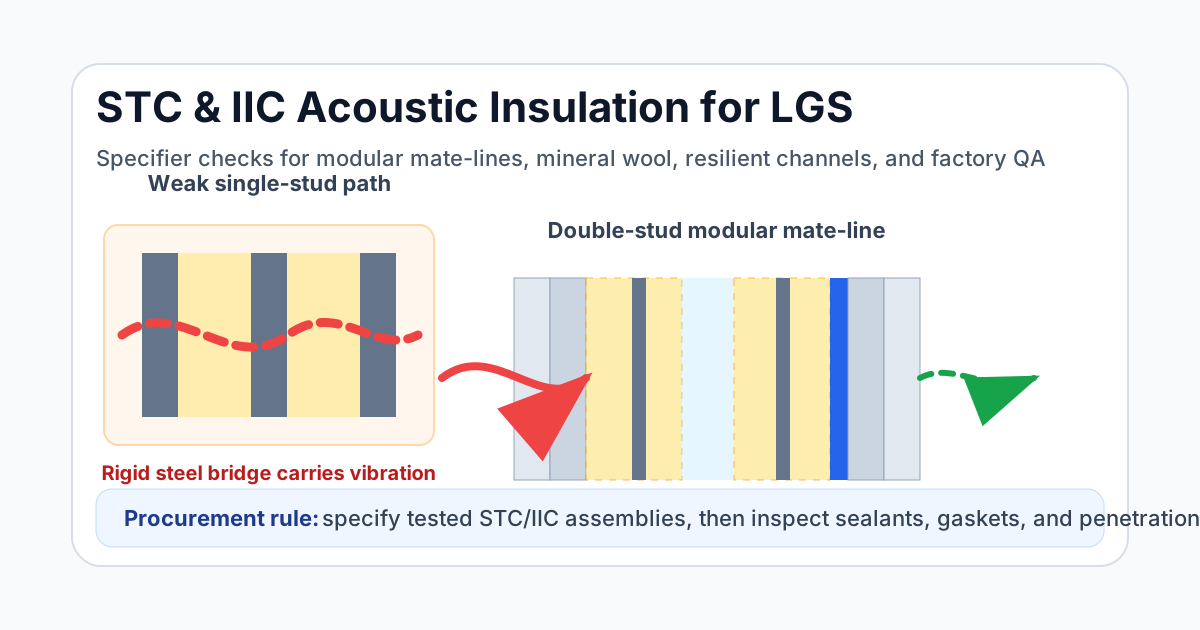
To specify effectively, one must understand how sound travels through steel. Sound is mechanical vibration. Steel is highly rigid and an excellent conductor of vibration. Therefore, a single LGS stud connecting two sheets of drywall acts as an acoustic bridge, efficiently transmitting vibration from one room to the next.
Mass, Decoupling, and Damping
Acoustic isolation in LGS construction relies on three fundamental engineering principles:
- Mass: Heavier materials block more sound. Upgrading from standard 12.5mm (1/2") drywall to 15.9mm (5/8") fire-rated Type X drywall adds critical mass. Mass is exceptionally important for stopping low-frequency sound waves.
- Decoupling: Breaking the mechanical connection between the two sides of a wall. If the drywall on side A is not physically attached to the same stud as the drywall on side B, sound vibrations cannot travel directly through the frame.
- Damping: Converting sound energy into heat energy. This is achieved using acoustic insulation in the wall cavity and visco-elastic acoustic sealants which never fully cure, allowing them to absorb micro-vibrations continuously.
The Flanking Noise Risk and Failure Scenarios
A wall might have a lab-tested STC of 60, but if the modular unit is improperly assembled, sound will simply travel around the wall. This is known as flanking transmission. Flanking paths include continuous floor joists, unsealed electrical outlets back-to-back in a shared wall, HVAC ductwork, and gaps at the floor/ceiling tracks.
Site Installation Risks: When importing volumetric modular units, the "mate-line" (where two modules join) is a critical high-risk area. If compressible acoustic gaskets are not factory-installed and compressed properly during site crane-in, flanking noise will destroy the STC rating. Furthermore, if modules settle unevenly during installation, rigid seals can crack, reopening flanking paths. This makes flexible, high-recovery EPDM gaskets absolutely non-negotiable for modular mate-lines.
3. Engineered Assemblies: Achieving High STC in LGS Modular
Procuring high-performance acoustic walls from an OEM manufacturer requires dictating specific assembly layers. Do not leave the build-up to the factory's discretion. Below are the industry-standard methods for upgrading LGS acoustic performance.
A. Resilient Channels (RC) and Resilient Sound Isolation Clips (RSIC)
The most cost-effective way to achieve STC 50+ on a single LGS stud wall is by decoupling the drywall from the framing using Resilient Channels (RC-1) or Resilient Clips with Hat Channels. Instead of screwing the drywall directly to the steel stud, the RC is attached horizontally to the studs, and the drywall is screwed into the RC. The flexible channel acts as a shock absorber, dissipating acoustic vibrations. The spacing of these channels (typically 16" or 24" on center) is a strict specification dimension that must be monitored during factory QA.
B. Staggered Stud and Double Stud Configurations
For premium acoustic performance (STC 60+), the physical connection must be completely broken.
- Staggered Stud: Uses a wider track (e.g., 150mm / 6") with alternating 90mm (3.5") studs. One side of the drywall attaches only to the even studs, the other only to the odd studs.
- Double Stud: Two completely separate parallel LGS frames with a 25mm (1") air gap between them. This is the gold standard for volumetric modular demising walls, as each module inherently possesses its own exterior frame, naturally creating a double-stud wall when bolted together on site.
C. Cavity Insulation and Mass Loaded Vinyl (MLV)
Standard fiberglass batts are insufficient for commercial multi-family standards. Specifications must mandate high-density mineral wool (Rockwool/Stone wool) filling at least 75% of the cavity depth. The density must be clearly specified (e.g., 40 kg/m³ to 60 kg/m³). In ultra-luxury or high-noise environments (e.g., near airports), adding a layer of Mass Loaded Vinyl (MLV) behind the drywall provides extreme mass and damping.
4. Benchmark Table: STC & IIC Assembly Comparisons
The table below illustrates the impact of different configurations on LGS wall and floor assemblies. Use this as a baseline when evaluating supplier capabilities and writing your Request for Quotation (RFQ).
| Assembly Configuration (LGS) | STC Rating (Lab) | IIC Rating (Floors) | Primary Application / Boundary | Code Compliance (IBC Multi-Family) | Estimated Cost Premium |
|---|---|---|---|---|---|
| Basic: Single 90mm Stud, R13 Fiberglass, 1/2" Drywall (1 layer each side) | 39 - 42 | N/A (Wall) | Interior single-unit partitions (bedrooms, closets). | ❌ Fails demising wall codes. | Baseline |
| Upgraded Single: 90mm Stud, Mineral Wool, 5/8" Type X Drywall (1 layer each side) | 45 - 47 | N/A | Corridors in low-budget commercial spaces. | ❌ Fails demising wall codes. | +1% to +2% |
| Decoupled: 90mm Stud, Mineral Wool, Resilient Channels, 5/8" Drywall (2 layers side A, 1 layer side B) | 52 - 55 | N/A | Standard multi-family separating walls. | ✅ Compliant (Minimum Spec). | +3% to +5% |
| Staggered Stud: 150mm Track, alternating 90mm studs, Mineral Wool, double 5/8" drywall | 58 - 60 | N/A | Premium apartments, shared corridors with high traffic. | ✅ Highly Compliant. | +6% to +8% |
| Double Stud (Mate-line): Two 90mm frames, 25mm gap, double mineral wool, double 5/8" drywall both sides | 63 - 68 | N/A | Luxury hotel and volumetric modular inter-module connections. | ✅ Highly Compliant (Premium). | +10% to +12% |
| Basic Floor: 200mm LGS Joist, 18mm Plywood Deck, standard ceiling below | 40 - 45 | 35 - 40 | Single family homes, within one unit. | ❌ Fails floor separation codes. | Baseline |
| Decoupled Floor: LGS Joist, Mineral Wool, Resilient Ceiling Channels, 18mm Plywood | 50 - 54 | 45 - 48 | Standard apartment floors (requires thick carpet to pass IIC). | ⚠️ Marginal (Depends on floor finish). | +4% to +6% |
| Premium Acoustic Floor: LGS Joist, Mineral Wool, RC ceiling, Acoustic Mat Underlayment, lightweight concrete topping | 58 - 62 | 55 - 60 | High-end multi-family / Hotels. Hardwood/Tile approved. | ✅ Highly Compliant (Premium). | +12% to +15% |
Planning boundary: Treat these ranges as RFQ normalization benchmarks, not universal certified ratings. Final STC/IIC performance depends on the tested assembly, gypsum board mass, fastener schedule, penetrations, floor finish, site installation, and the local code edition adopted by the authority having jurisdiction.
5. Buyer Decision Points & Supplier Communication Fields
When engaging with overseas manufacturers, ambiguity is your enemy. Your procurement team must articulate acoustic requirements using precise technical language to prevent suppliers from bidding with non-compliant, low-cost materials.
Mandatory RFQ Data Fields
Ensure your Request for Quotation (RFQ) and subsequent Purchase Orders (PO) include the following specific line items:
- Acoustic Target Metric: Clearly state "Minimum Lab STC 55 per ASTM E90" rather than "Good Soundproofing".
- Insulation Specification: "Mineral Wool Insulation, Minimum Density 40 kg/m³, 90mm thickness." Do not accept "Glass wool" or "Fiberglass" as an equivalent without structural review.
- Decoupling Mechanism: "Resilient Channels (RC-1) installed at 400mm (16") on-center horizontally."
- Sealant Requirement: "Non-hardening acoustic mastic sealant applied to all perimeter tracks and penetrations."
- Drywall Mass: "Minimum 15.9mm (5/8-inch) Type X Gypsum Board. Provide mass details (kg/m²)."
If a supplier pushes back on these fields or claims they are unnecessary, this is a major red flag indicating a lack of experience in commercial-grade modular manufacturing.
6. The 2026 Specifier & Procurement Checklist
When sourcing volumetric modular or LGS flat-pack systems from overseas, the factory's QA process is just as important as the design. Acoustic failures are rarely design flaws; they are usually execution flaws (missing sealant, compressed insulation, short-circuited resilient channels).
Use this comprehensive checklist during your factory audit, contract negotiation, and pre-shipment inspections:
✅ A. Engineering and Documentation
- Lab Reports Available: The manufacturer can provide independent, certified acoustic testing reports (e.g., from SGS, Intertek, UL, or CSIRO) for the exact LGS wall and floor assemblies they are proposing.
- BIM Detail Validation: The architectural shop drawings explicitly detail the acoustic sealant beads at the top and bottom tracks, around all penetrations, and at electrical boxes.
- MEP Penetration Policy: The factory engineering standards explicitly prohibit back-to-back electrical boxes in demising walls (must be staggered by at least 600mm / 24" and wrapped in putty pads).
- Deflection Track Detailing: Ensure the deflection tracks at the top of the walls do not compromise the acoustic seal while still allowing for structural movement.
✅ B. Material Specifications Verification
- Insulation Density Verification: Bill of Materials (BOM) specifies high-density mineral wool (minimum 40 kg/m³ density), not standard low-density fiberglass batts.
- Acoustic Sealants Application: Non-hardening, visco-elastic acoustic caulking is specified for all perimeter joints. Fire caulking is not a substitute for acoustic caulking, though specialized intumescent acoustic sealants exist that serve both functions.
- Drywall Screws & Resilient Channels: Ensure the factory uses the correct screw length for resilient channels. Critical: If a drywall screw is too long, it will pierce through the channel and hit the steel stud, short-circuiting the decoupling effect and destroying the STC rating. This single error can drop performance by 10 STC points.
✅ C. Factory QA and Pre-Shipment Inspection
- In-Process QA Checkpoint: Factory QA signs off on insulation placement and continuous acoustic sealing before the drywall is installed and the cavity is closed.
- Putty Pad Verification: Electrical boxes in shared walls are verified to be fully wrapped in acoustic putty pads prior to drywall installation.
- Mate-Line Gaskets (Volumetric): For volumetric modules, high-performance compressible EPDM or neoprene gaskets are supplied and pre-installed along the mate-lines to seal the air gap during site installation.
- Mock-up Testing: For large commercial projects, stipulate a Field Sound Transmission Class (FSTC/ASTC) test on the first completed prototype module (Mock-up) before mass production begins.
7. Procurement Scenarios: Acoustic Remediation vs. Proactive Engineering
To understand the value of strict acoustic specifications in your procurement process, use the following composite scenarios as a cost-consequence model. They reflect common failure patterns in modular procurement, but they are not named project claims.
Failure Scenario: A Costly Remediation Lesson
A developer imports 120 volumetric modules for a student accommodation project without stipulating specific acoustic requirements. The factory uses standard fiberglass insulation, no resilient channels, and fails to apply acoustic sealant around electrical boxes. Once assembled on-site, the building achieves an FSTC of only 41 between units. Students can hear conversations and televisions clearly from adjacent rooms. The local municipality refuses the occupancy permit. To fix the issue, the developer has to:
- Hire acoustic engineers for extensive site testing.
- Remove all baseboards and crown molding.
- Install a secondary layer of 5/8" mass-loaded drywall using specialized acoustic green glue over the existing walls.
- Extend all electrical boxes to meet the new wall depth.
- Re-tape, mud, and paint all demising walls. Total Remediation Cost: Over $350,000, plus a four-month delay in rental income. The perceived "savings" from the low-bid factory were instantly wiped out.
Proactive Scenario: Engineered for Silence
A proactive luxury hotel procurement team uses the strict checklist outlined in this guide. The procurement team mandates STC 60 assemblies using double LGS studs, 50 kg/m³ mineral wool, and rigorous factory QA for acoustic sealants. They also require the factory to perform an acoustic mock-up test before mass production. When the modules are craned into place, the mate-line gaskets compress properly. Post-installation field testing results in an ASTC of 58, exceeding the hotel brand standard. Result: Zero remediation costs, immediate occupancy permit approval, and premium guest satisfaction scores regarding room quietness. The upfront cost premium for the upgraded assemblies was approximately 4%, which was easily absorbed by the higher daily room rates the developer could charge for a premium acoustic environment.
8. Real-World Applications: Managing Risk in Modular Procurement
The financial risk of acoustic failure is immense. If a completed hotel or multi-family building fails its pre-occupancy acoustic testing (Field STC testing), the local building inspector will not issue a Certificate of Occupancy. Rectifying an STC failure post-construction involves tearing down finished drywall, installing secondary walls, relocating electrical services, or injecting expensive acoustic foams—effectively destroying the ROI and speed advantage of the modular methodology.
By locking in the specifications from the checklist above in the master supply agreement, developers shift the compliance liability back to the manufacturer. High-quality overseas LGS suppliers understand these international codes and already have a library of tested, certified assemblies ready for immediate deployment. Low-tier, inexperienced suppliers will resist providing testing reports, attempt to substitute materials with cheaper alternatives (like standard fiberglass), and argue that specialized sealing is "unnecessary."
9. Next Steps: Secure Your Acoustic Performance
Specifying LGS modular housing requires an engineering-first approach. Do not let outdated misconceptions about steel and noise limit your procurement strategy. With the right decoupled assemblies, high-density insulation, rigorous specification fields, and strict factory QA, LGS provides a superior, quieter environment than traditional timber framing, achieving luxury-grade acoustics at a commercial scale.
Partner with GFK Commercial
At GFK Commercial, we specialize in high-performance LGS modular structures designed to meet the rigorous demands of global commercial development. Our engineering team provides fully certified STC and IIC assemblies tailored to your specific building code requirements, ensuring your project is compliant, quiet, and highly profitable.
Contact our engineering and procurement team today to request a technical review of your modular project requirements and access our proprietary library of tested acoustic assemblies.
Sources & References
- International Code Council (IBC) Section 1206: Sound Transmission requirements governing STC 50 and IIC 50 minimums for residential separations. Read the IBC Section 1206 Code
- Steel Framing Industry Association (SFIA): Fire and acoustic assembly resources for cold-formed steel floor, wall, and roof assemblies. SFIA Documents Repository
- ASTM International - ASTM E90: Standard Test Method for Laboratory Measurement of Airborne Sound Transmission Loss of Building Partitions and Elements. View ASTM E90 standard
- ASTM International - ASTM E492: Standard Test Method for Laboratory Measurement of Impact Sound Transmission Through Floor-Ceiling Assemblies. View ASTM E492 standard
- Steel Construction Institute (SCI): Acoustic performance guidance for light steel framed walls and floors, including mass, decoupling, and flanking considerations. Acoustic Performance of Light Steel Framed Systems
Author

Categories
More Posts

Flat-Pack LGS vs. Volumetric Modular Imports: A 2026 Logistics & Sourcing Guide
A deep dive into the logistics, container economics, and procurement strategies for importing flat-pack Light Gauge Steel (LGS) versus 3D volumetric modular structures.
Fire Resistance Standards for Imported LGS Modular Buildings: A 2026 Procurement Guide
Compare LGS fire resistance standards for modular imports, verify supplier test reports, and request GFK engineering review before procurement approval.
Corrosion Protection in LGS Modular Construction: Galvanized vs. Galvalume for Coastal Projects
An engineering and procurement guide to specifying the correct steel coating for Light Gauge Steel (LGS) modular buildings in coastal environments. Compare Z275 Galvanized vs. AZ150 Galvalume.