
Flat-Pack LGS vs. Volumetric Modular Imports: A 2026 Logistics & Sourcing Guide
A deep dive into the logistics, container economics, and procurement strategies for importing flat-pack Light Gauge Steel (LGS) versus 3D volumetric modular structures.
The global construction industry is undergoing a massive structural shift in 2026. Facing unprecedented labor shortages, volatile local material costs, and aggressive project deadlines, developers, procurement teams, and distributors are increasingly looking overseas to source prefabricated building systems.
However, the decision to import off-site construction is immediately followed by a critical supply chain dilemma: Should you procure fully finished 3D volumetric modules, or 2D flat-pack Light Gauge Steel (LGS) panelized systems?
This decision dictates your entire project's financial viability. Make the wrong choice, and the freight costs, crane rentals, and site logistics will completely erase the savings gained from offshore manufacturing.
This guide provides a comprehensive comparison of flat-pack LGS and volumetric modular construction, focusing strictly on the hard economics of global logistics, procurement strategies, and application boundaries for commercial buyers.
For a project-specific route, load-plan, and structural scope review, use this guide with our LGS technology overview, buyer guide, and contact form.
1. The Core Distinction: Form Factor at the Factory Gate
To make an informed procurement decision, we must precisely define the condition of the asset as it leaves the overseas OEM facility.
Volumetric Modular (3D): These are three-dimensional, fully enclosed box-like structures. In a turnkey scenario, they leave the factory with interior finishes, MEP (Mechanical, Electrical, Plumbing) pre-installed, flooring, and even fixtures in place. The appeal is obvious: drop it on a foundation, connect the services, and open the doors.
Flat-Pack LGS / Panelized (2D): A "kit of parts." The Light Gauge Steel is roll-formed using advanced CNC machinery, assembled into 2D wall panels, floor joists, and roof trusses at the factory, and then stacked flat. They arrive on-site as a highly organized, numbered system of structural frames ready for rapid bolting and subsequent on-site finishing.
Method and Scope
This analysis is written for importers comparing overseas OEM supply options before an RFQ is finalized. It uses a practical 40ft high-cube dry container as the freight baseline, assumes a cross-border or ocean-freight supply chain, and focuses on the structural shell rather than local foundation, approval, or fit-out costs. Exact unit counts depend on panel dimensions, bracing strategy, opening sizes, route limits, and the supplier's nesting plan, so buyers should treat the ranges below as RFQ stress tests rather than universal price guarantees.
2. The Logistics Mathematics: Shipping Container Economics
The fatal flaw of importing volumetric modular units from overseas is freight inefficiency. When you pay for a 40-foot High Cube (40' HC) container, you are paying for the total internal volume (approx. 76 cubic meters).
If you place a fully assembled 3D module inside that container, 80% of the volume you are shipping is literal air. As ocean freight rates fluctuate, this "air shipping" drastically dilutes the cost-savings of offshore procurement.
Conversely, flat-pack LGS panels are engineered to nest tightly. An experienced OEM factory will run the BIM model through nesting software to optimize the exact load plan for a shipping container, minimizing dead space.
Volumetric vs. Flat-Pack Logistics Comparison
| Logistics Variable | Volumetric (3D) Modules | Flat-Pack (2D) LGS Panels | Implication for Importers |
|---|---|---|---|
| Container Utilization | Extremely Low (mostly air) | Exceptionally High (nested panels) | Flat-pack drastically reduces per-unit sea freight costs. |
| Units per 40ft HC | 1 to 2 small units | Frames for 4 to 6 equivalent units | Bulk procurement is highly lucrative with flat-pack. |
| Inland Transport | Requires wide-load permits & escorts | Standard flatbed or container chassis | Volumetric inland freight can exceed sea freight costs. |
| Site Access Constraints | Requires massive, clear access roads | Negotiable with standard trucks | Flat-pack is viable for dense urban infill or remote terrain. |
| Lifting Equipment | Heavy-duty commercial cranes ($$$) | Forklifts, telehandlers, or light cranes | Crane rental delays and costs severely impact 3D ROI. |
| Damage Risk in Transit | High (drywall cracking, window breaks) | Near Zero (steel panels are highly durable) | Volumetric requires extensive post-transit rework/repair. |
| Staging Area Required | Massive (cannot be easily stacked) | Minimal (flat stacks footprint is small) | Flat-pack excels on tight, constrained construction sites. |
| Customs & Inspection | Complex (hidden MEP routing) | Transparent (open frames) | Open steel frames clear border inspections much faster. |
The Procurement Verdict: If your supply chain crosses an ocean, flat-pack LGS is the only mathematically sound choice for the structural framing. Volumetric imports only make economic sense when the factory is located within a few hundred miles of the final construction site.
Before you award a purchase order, ask the supplier for a container loading drawing, gross cargo weight, estimated cubic utilization, and the freight cost per delivered square foot. If those four fields are missing, the proposal is not ready for a commercial comparison.
3. On-Site Assembly vs. The "Turnkey" Illusion
A common argument from procurement teams favoring volumetric modules is the reduction of on-site labor. "We just drop it in place."
However, this is often a dangerous illusion for imported modules. Imported 3D modules inevitably suffer micro-movements during a 6,000-mile ocean voyage. Drywall cracks, tile grout loosens, and MEP connections shift. Upon arrival, a local crew must still be mobilized to "stitch" the modules together, weather-seal the joins, repair transit damage, and connect the primary utilities. The labor required for this remedial work often matches the labor required to simply erect a flat-pack LGS frame.
The Precision of CNC Flat-Pack
Modern flat-pack LGS is not like stick-building with timber. It is an advanced engineering system.
- The structural model is finalized in BIM.
- The CNC roll-former cuts the G550 steel to sub-millimeter precision.
- Every service hole (for plumbing/wires) is pre-punched in the factory.
- Every dimple and connection point is pre-pressed.
- Every single stud and track is inkjet-printed with an assembly code (e.g., W1-A, W1-B).
Because the engineering is handled by the software and the cutting is handled by the robot, the on-site erection becomes a fast, idiot-proof assembly process. A small crew with screw guns can erect the framing of a commercial structure in a fraction of the time it takes to build with red iron or timber, without the catastrophic logistics costs of moving 3D boxes.
For deeper factory-audit criteria, pair this section with our overseas LGS manufacturer procurement checklist before you issue supplier questionnaires.
4. Application Boundaries: When to Spec Flat-Pack LGS
Procurement teams must align the sourcing strategy with the specific asset class being developed.
Where Flat-Pack LGS Dominates:
- Mid-Rise Commercial & Residential (1-6 Stories): Flat-pack LGS is the undisputed king of load-bearing walls and joists for mid-rise structures. It is lightweight, non-combustible, and highly precise.
- Remote or Island Developments: If you are building a resort in the Caribbean or a mining camp in remote Australia, getting a wide-load volumetric module to the site is physically impossible. Flat-pack LGS on standard trucks is the only solution.
- Complex Architectural Designs: Volumetric modules force architects into "box" designs. Flat-pack LGS can be roll-formed to accommodate varied roof pitches, curved walls, and expansive open spans.
- High Wind & Seismic Zones: LGS framing provides exceptional ductility and strength-to-weight ratios, outperforming heavy, rigid 3D modules in earthquake-prone regions.
Where Volumetric Makes Sense:
- Highly repetitive, cellular floor plans (e.g., standard motel rooms, student dormitories) where the factory is geographically adjacent to the site.
Procurement & Engineering Decision Matrix
| Decision Factor | Flat-Pack LGS (2D) | Volumetric Modular (3D) | Buyer Action Point |
|---|---|---|---|
| Ocean Freight Distance | > 500 miles (Ideal) | < 500 miles (Cost prohibitive otherwise) | Calculate freight cost per square foot before committing. |
| Site Access | Tight urban infill, remote terrain | Requires wide roads, massive staging area | Survey delivery route for wide-load feasibility. |
| Labor Availability | Minimal skilled labor needed (assembly) | Requires specialized crane & stitching crews | Assess local crane rental rates and availability. |
| Design Flexibility | High (customizable roof lines, spans) | Low (rigid box constraints) | Align architectural intent with factory capabilities. |
| Quality Control Location | Factory (framing) + On-site (finishes) | 90% Factory | Hire 3rd party QA/QC for overseas factory sign-off. |
| Customs Inspection | Straightforward (visible framing) | Complex (hidden cavities) | Prepare documentation for concealed MEP if choosing 3D. |
| Project Timeline Focus | Fast framing, standard finishing | Fast on-site, longer factory lead time | Map critical path: site prep vs. factory production. |
| Financing Structure | Standard construction loan | Requires large upfront factory deposits | Ensure lender understands off-site manufacturing milestones. |
If the project is a labor-driven rollout rather than a freight-driven import, also review how LGS modular construction reduces on-site labor exposure. The best sourcing answer changes when your bottleneck is local trade capacity rather than ocean freight.
5. The 2026 Import Procurement Checklist
If you are a developer, distributor, or general contractor looking to import flat-pack LGS systems, you must audit your overseas OEM partner ruthlessly. Use this checklist to filter out low-tier fabricators.
✅ Phase 1: Engineering & BIM Verification
- Software Stack: Does the factory utilize Tier-1 structural BIM software (e.g., Vertex BD, FrameCAD) rather than rudimentary 2D CAD?
- Code Compliance: Can their engineering team provide structural calculations signed off for your specific local building codes (e.g., ICC-ES, Eurocode, NCC)?
- Clash Detection: Are MEP service holes modeled and clash-tested in the software before the steel is cut?
✅ Phase 2: Material Specifications
- Steel Grade: Ensure the contract explicitly mandates high-tensile structural steel (Yield strength ≥ 550 MPa, e.g., G550/S550), not commercial-grade G300.
- Coating Mass: Verify the anti-corrosion coating. Require minimum Z275 (galvanized) or AZ150 (Aluzinc/Galvalume) for longevity.
- Traceability: Demand batch-specific Mill Test Certificates (MTC) prior to container loading.
✅ Phase 3: Manufacturing & Logistics Readiness
- CNC Automation: Confirm the factory uses fully automated roll-forming lines with a tolerance of ±0.5mm.
- Nesting Optimization: Ask to see the proposed container loading plan. How many panels/frames fit in one 40' HC?
- Export Packaging: Ensure panels are strapped with heavy-duty steel banding, separated by dunnage, and wrapped in moisture-resistant barriers for the sea voyage.
✅ Phase 4: Inquiry & Spec Confirmation Fields
- Structural Load Requirements: State exact wind speed (e.g., 150 mph), seismic zone, and snow load in your RFQ.
- Acoustic & Thermal Targets: Define required STC ratings and R-value/U-value targets upfront.
- Local Fastener Approvals: Confirm if factory-supplied bolts/screws meet your local building code or if they must be sourced domestically.
- MEP Integration Plan: Clarify exactly who is responsible for pre-punching service holes and providing grommets.
6. Risk Management and Supply Chain Resilience
Importing building materials inherently carries risk. The flat-pack LGS methodology inherently mitigates the three largest threats to an international construction supply chain, but introduces its own failure risks if not managed.
Key Mitigation Points:
- Freight Volatility: Because you fit vastly more square footage of building into a single container, you are heavily insulated against sudden spikes in ocean freight rates.
- Transit Damage: Steel panels strapped flat to a pallet are nearly indestructible during typical maritime transport. Fully finished 3D modules with glass, drywall, and paint are highly vulnerable to rough seas and crane drops.
- Site Delays: If a site foundation is delayed by weather, storing 40 containers of flat-pack LGS requires a small staging yard. Storing 40 volumetric modules requires acres of secured land.
Failure Risks to Monitor:
- Incomplete Fastener Supply: If the factory shorts your shipment of proprietary screws, your site grinds to a halt. Always mandate a 5-10% overage of all fasteners.
- Lost Assembly Plans: Ensure the 3D assembly models (usually viewed on tablets via software like Vertex BD) and 2D shop drawings are backed up locally.
- Rust During Transit: If moisture barriers tear during loading, sea salt air can initiate surface rust on cut edges. Mandate VCI (Volatile Corrosion Inhibitor) packaging.
7. Frequently Asked Questions (FAQ)
Q: What happens if a flat-pack LGS container is flagged for customs inspection?
Unlike 3D volumetric modules with hidden wall cavities that customs agents may need to drill into to inspect, flat-pack LGS is shipped as open, visible steel frames. Inspections are typically visual and proceed much faster, avoiding costly demurrage fees.
Q: How do we handle MEP (Mechanical, Electrical, Plumbing) integration if the factory only provides the bare LGS frame?
During the BIM design phase, your engineering team coordinates with the factory to pre-punch all service holes exactly where the MEP routing needs to go. Plumbers and electricians simply run their lines through these pre-cut, grommeted holes on-site, significantly speeding up rough-in times.
Q: Are the exposed steel connections vulnerable to rust during a 6-week sea voyage?
It is a valid risk. This is why you must specify Z275 galvanized or AZ150 Aluzinc coatings, and mandate that the factory packages the steel stacks using VCI (Volatile Corrosion Inhibitor) film and includes desiccant bags inside the shipping container.
Q: What is the typical payment structure for overseas flat-pack LGS procurement?
Standard terms are usually 30% T/T deposit to commence engineering/BIM and order raw steel, and 70% balance T/T before the containers are loaded onto the vessel (often upon presentation of the Bill of Lading and inspection reports). Never pay 100% upfront.
8. Conclusion: The Smart Capital Move
For commercial developers and procurement professionals looking to leverage offshore manufacturing economics in 2026, the data is unequivocal. Attempting to ship empty air across the ocean via volumetric modules is a logistical trap.
Flat-pack LGS panelized systems offer the perfect equilibrium. You capture the massive cost benefits of overseas automated CNC manufacturing, you optimize your sea and land freight costs to the absolute minimum, and you deliver a high-tensile, hyper-accurate engineered structure to your site.
Streamline Your LGS Procurement with GFK Commercial
At GFK Commercial, we specialize in the engineering, automated manufacturing, and optimized export of premium flat-pack Light Gauge Steel framing. We understand the complex container math and the stringent compliance requirements of global markets.
Stop paying to ship empty air. Contact our engineering team today to discuss your next project, and let us show you how a precision flat-pack LGS strategy can drastically reduce your structural costs and accelerate your timeline.
Sources
| Source / Organization | Why it matters to this topic | URL / Reference |
|---|---|---|
| Maersk Equipment Specifications | Confirms the approximate 76 m3 internal volume used for 40ft high-cube dry-container math. | maersk.com |
| Freightos Baltic Index (FBX) | Provides a market reference for ocean freight volatility and 40ft container spot-rate benchmarking. | freightos.com |
| AISI S240 Cold-Formed Steel Structural Framing | Defines the engineering standard family behind cold-formed steel structural framing used in LGS systems. | shop.steel.org |
| Modular Building Institute | Establishes the commercial modular construction context, including volumetric modular terminology and industry practice. | modular.org |
| World Steel Association | Supports steel material context, lifecycle considerations, and steel industry terminology for structural procurement. | worldsteel.org |
| Steel Framing Industry Association | Gives cold-formed steel framing guidance relevant to coating, framing quality, and field installation expectations. | steelframing.org |
Author

Categories
More Posts

Australia Modular Housing Market Update (Week 17, 2026): NSW Assessment Guidance, NHVR Access Settings, and Buyer Cost Signals
Decision-focused update for 22 April 2026: NSW guidance changes, NHVR notice settings, and cost/dispatch implications for expandable homes and transportable accommodation buyers.
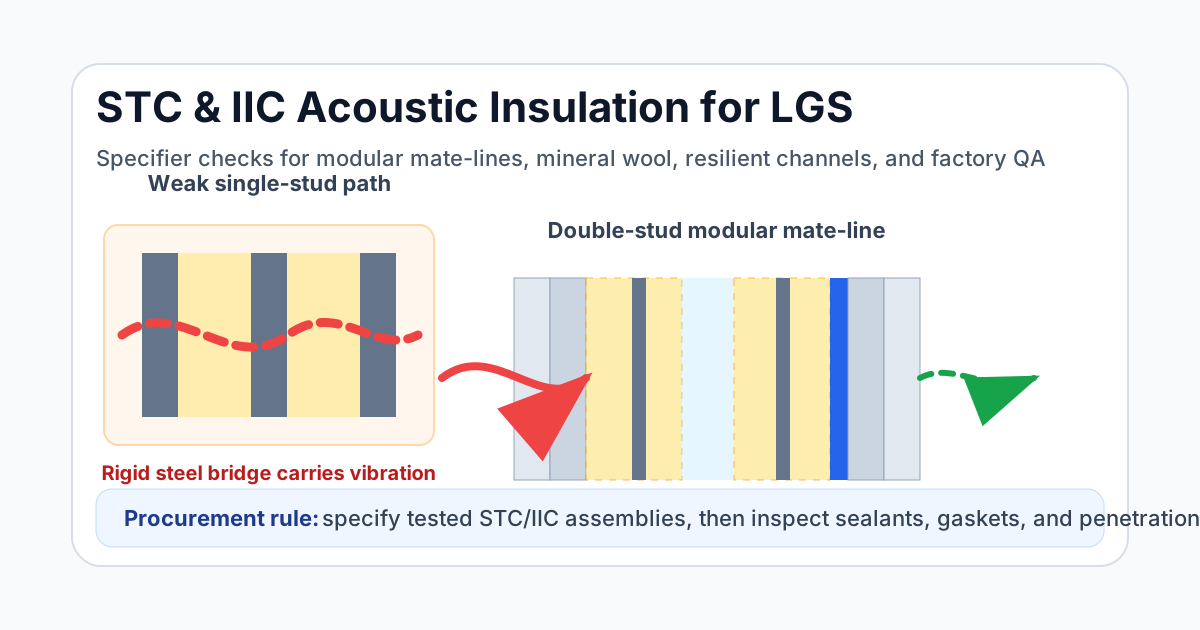
Acoustic Insulation (STC & IIC) in LGS Modular Housing: A 2026 Specifier's Guide
Specify acoustic insulation for LGS modular housing with STC/IIC targets, flanking controls, supplier QA fields, and a technical review CTA from GFK.
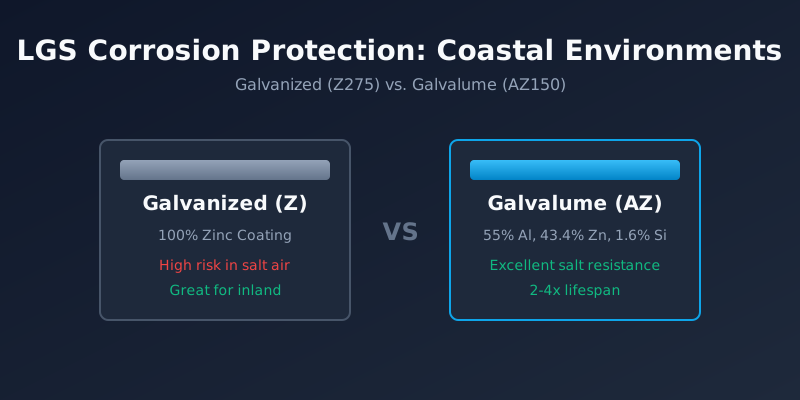
Corrosion Protection in LGS Modular Construction: Galvanized vs. Galvalume for Coastal Projects
An engineering and procurement guide to specifying the correct steel coating for Light Gauge Steel (LGS) modular buildings in coastal environments. Compare Z275 Galvanized vs. AZ150 Galvalume.