
How to Evaluate an Overseas LGS Modular Manufacturer: A 2026 Procurement Checklist
A comprehensive guide for developers and procurement teams on auditing Light Gauge Steel (LGS) modular suppliers. Covers ISO standards, CNC automation, steel grades, and QA.
As construction labor costs soar and traditional framing schedules become increasingly unpredictable, commercial developers are turning to overseas Light Gauge Steel (LGS) modular manufacturing. Sourcing flat-pack LGS frames or fully volumetric modular units from international OEM partners can reduce structural costs by up to 40% and accelerate project timelines.
However, not all overseas factories are created equal. The influx of new suppliers in 2026 means procurement teams must exercise rigorous due diligence to separate Tier-1 engineering partners from low-quality fabricators.
In this guide, we provide a definitive methodology and checklist for evaluating an LGS modular manufacturer to ensure your imported structures meet global compliance, quality, and durability standards.
1. Verify Steel Grade and Anti-Corrosion Coatings
The foundational quality of any LGS building is the raw steel coil itself. Substandard steel compromises structural integrity and drastically shortens the building's lifespan.
When auditing a factory, always verify the steel yield strength and the metallic coating specification.
Structural vs. Commercial Steel Grades
LGS framing requires structural-grade steel, typically classified as G550 (or S550 in some regions), which has a minimum yield strength of 550 MPa. Some factories quote lower prices by secretly substituting commercial-grade steel (e.g., G300), which is entirely unsuitable for load-bearing modular walls and trusses.
Anti-Corrosion Coating Comparison
The metallic coating protects the steel frame from rust and environmental degradation. Zinc (Galvanized) and Aluminum-Zinc alloys (Aluzinc/Galvalume) are the industry standards.
| Coating Type | Coating Mass | Lifespan Estimate | Best Use Case |
|---|---|---|---|
| Z275 (Galvanized) | 275 g/m² (Zinc) | 50+ Years | Standard inland residential and commercial framing. |
| AZ150 (Aluzinc/Galvalume) | 150 g/m² (Alu/Zinc) | 50+ Years | Coastal or high-humidity environments. Offers superior long-term barrier protection. |
| Z120 / AZ70 (Low-Grade) | <120 g/m² | <15 Years | Warning: Often used by low-cost suppliers. Prone to early-onset corrosion; fails modern building codes. |
Procurement Action: Always demand the Mill Test Certificate (MTC) for the specific coil batch being used for your project to verify both tensile strength and coating mass.
2. Evaluate BIM Integration and CNC Automation
The primary advantage of LGS construction is precision. If a manufacturer relies on manual cutting or rudimentary punching machines, you lose the "assembly-line" benefits of the LGS method.
Tier-1 manufacturers operate a seamless digital thread from 3D design to factory floor.
- BIM Software: Do they use internationally recognized software like Vertex BD or FrameCAD to generate the structural model and structural calculations?
- CNC Roll Formers: Do their machines automatically punch service holes (for plumbing and electrical), dimple connections, and ink-jet print assembly numbers on every single piece?
- Tolerances: The factory should guarantee dimensional tolerances of ±0.5mm.
3. The 2026 Developer's Procurement & QA Checklist
Before signing an OEM contract or issuing a Purchase Order, use this checklist to audit the manufacturer.
✅ A. Engineering & Design Capabilities
- Factory has an in-house structural engineering team familiar with your local codes (e.g., IBC/IRC, NCC, Eurocode).
- Capable of providing signed engineering calculations for wind (e.g., cyclonic/hurricane zones) and seismic loads.
- Provides fully detailed 3D BIM models before production begins.
✅ B. Material Quality Assurance
- Confirms the use of G550/S550 high-tensile steel.
- Confirms minimum Z275 or AZ150 anti-corrosion coating.
- Readily provides authentic, batch-specific Mill Test Certificates (MTC).
✅ C. Manufacturing & Factory Audit
- Factory holds current ISO 9001:2015 certification for quality management.
- Operates advanced CNC roll-forming machines directly integrated with BIM software.
- Has an established internal QA process: random sampling of dimensions, punch accuracy, and coating thickness using electronic micrometers.
✅ D. Logistics & Export Readiness
- Optimizes flat-pack nesting to maximize shipping container space (reducing per-unit freight costs).
- Uses robust export packaging (moisture-barrier wraps, heavy-duty steel strapping) to prevent transit damage.
- Provides clear, English-language assembly plans and sequentially numbered components.
4. Understanding Global Certifications
A reliable overseas manufacturer does not just claim quality; they prove it through third-party certifications recognized in your jurisdiction.
- North America: Look for ICC-ES (International Code Council Evaluation Service) reports or UL certifications for fire-rated wall assemblies.
- Australia / New Zealand: Demand compliance with the National Construction Code (NCC), specifically AS/NZS 4600 for cold-formed steel structures. CodeMark or WaterMark (for modular plumbing) is highly advantageous.
- Europe & UK: CE Marking is mandatory for structural steel components (EN 1090). For residential housing in the UK, BOPAS (Buildoffsite Property Assurance Scheme) readiness is a strong indicator of quality.
5. Conclusion: Partnering for Project Success
Procuring LGS modular housing from overseas is an incredibly powerful strategy to hedge against local labor shortages and inflation. However, treating LGS framing as a cheap commodity rather than an engineered system is a costly mistake.
By demanding high-tensile steel, CNC precision, and strict QA documentation, developers can eliminate on-site delays, reduce rework to zero, and deliver superior assets.
Streamline Your Procurement with GFK Commercial
At GFK Commercial, we don't just supply steel—we supply certainty. Our OEM manufacturing facility operates to the highest global standards, delivering precision-engineered, code-compliant LGS modular solutions for commercial developers worldwide.
Contact our engineering team today to review your project blueprints and receive a comprehensive LGS manufacturing proposal.
Sources & References
- World Steel Association: Guidelines on the sustainability and lifecycle of cold-formed steel in construction.
- International Code Council (ICC): ICC-ES Evaluation Reports for Cold-Formed Steel Framing.
- Australian Building Codes Board (ABCB): NCC 2025 updates regarding structural provisions and energy efficiency in modular buildings.
- Steel Framing Industry Association (SFIA): Standards for protective coatings (Z275/AZ150) and manufacturing tolerances.
- ISO 9001:2015: Quality management systems requirements applied to structural manufacturing.
Author

More Posts

Thermal Bridging & Insulation in LGS Modular Construction: A 2026 Procurement Guide to Global Energy Codes
Compare LGS thermal bridging, continuous insulation, and effective R-value checks for 2026 modular procurement under IECC and ASHRAE energy codes.

How Developers Use LGS Modular Construction to Hedge Against Rising Labor Costs
Discover why commercial developers in the US, UK, and Australia are pivoting to Light Gauge Steel (LGS) modular manufacturing to bypass skilled labor shortages and site delays.
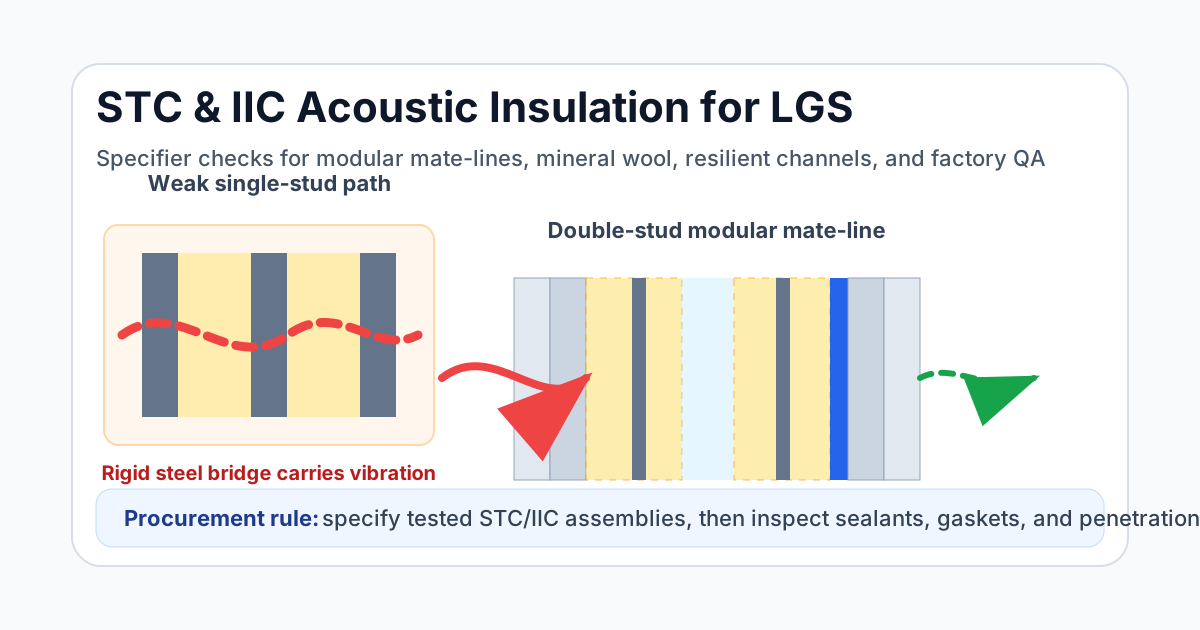
Acoustic Insulation (STC & IIC) in LGS Modular Housing: A 2026 Specifier's Guide
Specify acoustic insulation for LGS modular housing with STC/IIC targets, flanking controls, supplier QA fields, and a technical review CTA from GFK.